Pirate Character Design: Ideas, Shape Language and Inspiration
Part of Character Design Gallery: Design Studies and Breakdowns
See the original work
Titan Books
Official art book
by The Art of Assassin's Creed IV: Black Flag (Paul Davies)
Art book for Ubisoft's 2013 game, which is set in the West Indies during the Golden Age of Piracy (1715–1722).
See Official art book on Titan Books (opens in a new tab) ↗Titan Books
Official art book
by The Art of Assassin's Creed Black Flag Resynced
Titan Books lists this art book by Ubisoft and Paul Davies for the Black Flag Resynced release.
See Official art book on Titan Books (opens in a new tab) ↗Pirate concept art is costume design with a story attached. A tricorn hat, a long coat, a sash and a pistol say “pirate” instantly, but the best pirate designs also tell you who the character is: a ruthless captain, a weathered deckhand, a navigator who trusts maps more than people. This guide breaks pirate character design into silhouette, shape language, costume, props and color, using our own diagrams and two annotated 18th-century objects from The Met. For professional pirate concept art, see the official art books linked above; we link to them instead of showing their images.
What makes pirate concept art work
Strong pirate designs usually combine three things:
- A period silhouette. Hats, long coats with flared skirts, wide boots and sashes come from real late-17th and 18th-century clothing. That history makes even fantasy pirates feel grounded.
- Wear and improvisation. Pirates mix whatever they’ve taken: a gentleman’s coat over a sailor’s shirt, a captured officer’s hat, mismatched weapons. Wear and patching tell their story.
- Crew logic. Every crew member should read as part of the same ship, through shared colors, a repeated emblem or similar materials, while keeping their own silhouette.
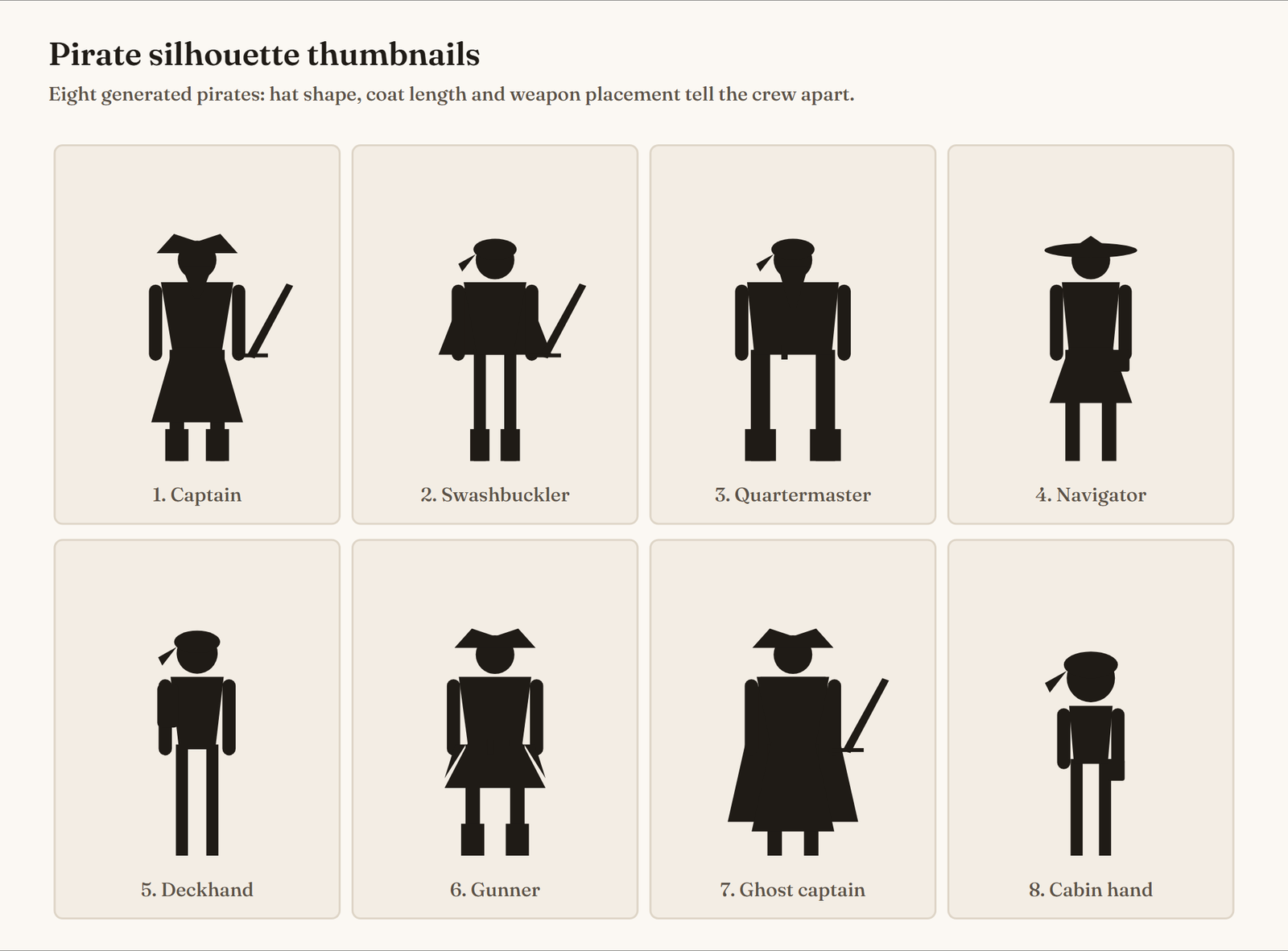
The silhouettes at the top of this page show how much the crew can vary with only hats, coats and weapon placement.
Shape language for pirates
Shape language decides whether the audience trusts a character before they speak. Our guide to character design basics covers the idea in depth.
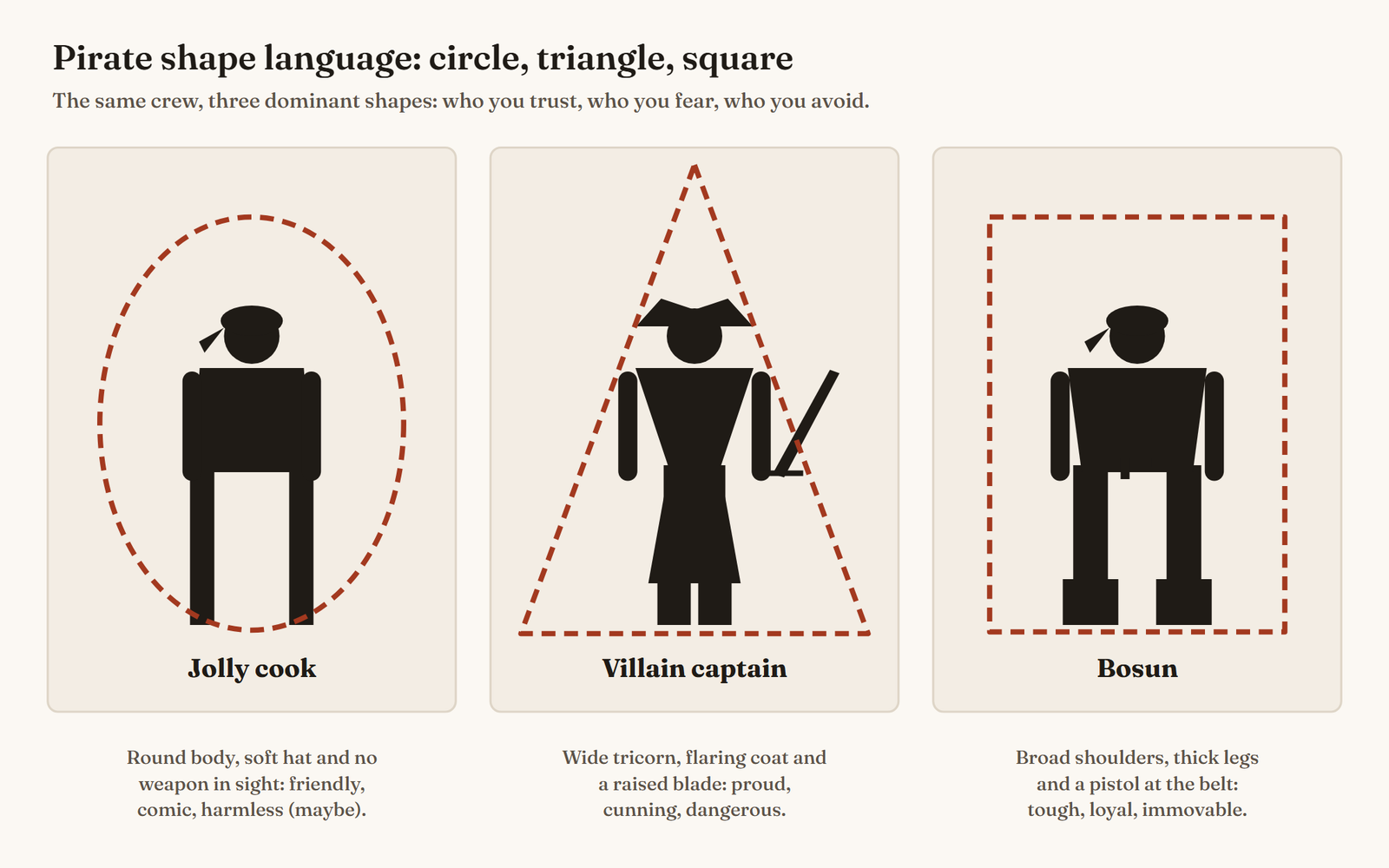
A round cook with a soft hat feels friendly and comic. A villain captain built from triangles (a wide tricorn, a flaring coat, a raised blade) feels proud and dangerous. A square bosun with broad shoulders and thick legs feels tough and immovable. Mixing the three shapes across a crew gives you instant variety.
Blocking in the pirate costume
Block the costume in over an action pose. Pirate coats, sashes and blades are designed to move, so a lunge shows quickly whether the design works.
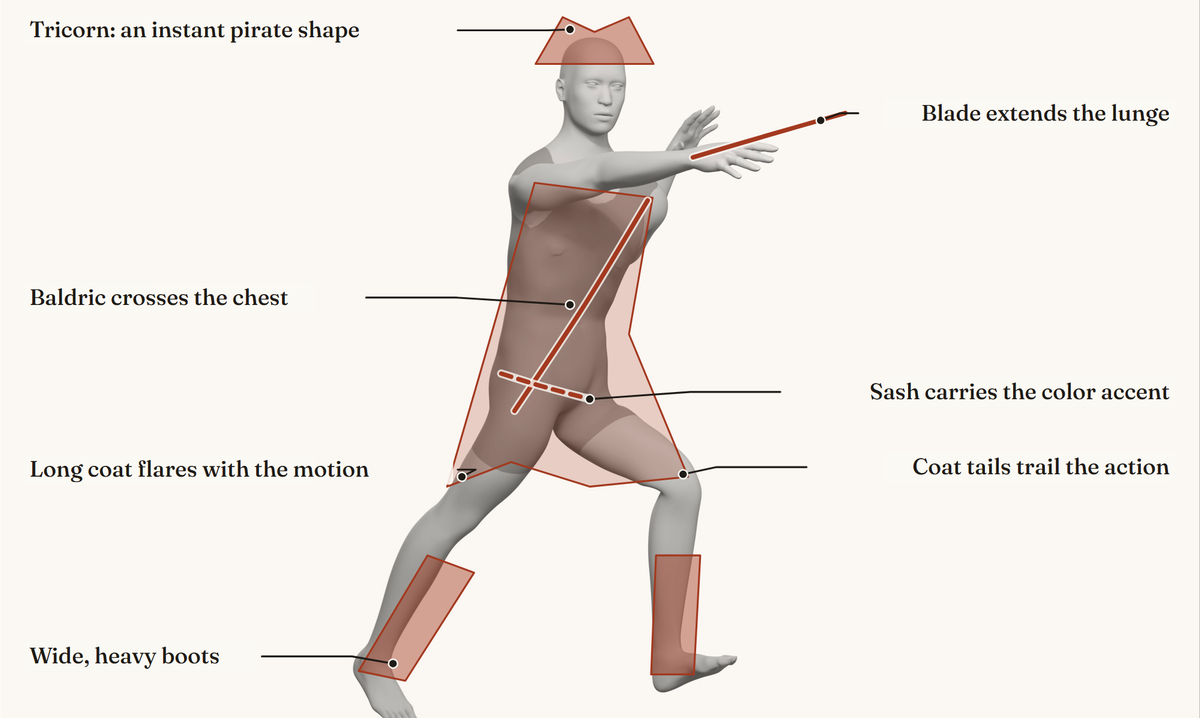
- Tricorn or bandana: the hat is the strongest shape at the top of the silhouette.
- Long coat: the flared skirts trail the action and exaggerate every movement.
- Baldric: a diagonal strap across the chest breaks up the torso and carries a sword.
- Sash: the perfect place for the character’s color accent and a tucked pistol.
- Boots: wide, heavy boots anchor the figure and balance the big coat.
The pirate coat: lessons from history
The pirate coat is an 18th-century gentleman’s coat that has lived a hard life. This British riding coat from about 1760, released by The Met as public domain, shows the construction that makes the shape work.
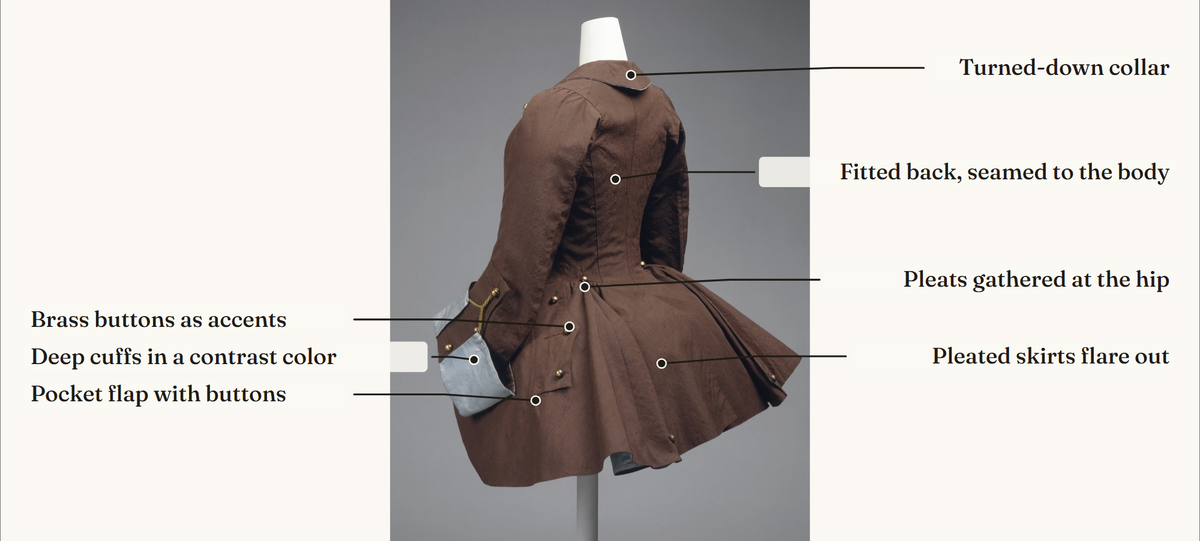
Notice the fitted back, the pleats gathered at the hip that make the skirts flare, the deep cuffs in a contrasting color and the brass buttons used as accents. Keep that structure and change the story: fray the hem, replace a button with a coin, stain the cuffs with salt, or add a captured officer’s braid.
Pistols and props
Pirate props carry personality, and real historical objects are full of design ideas. This British flintlock pistol from about 1700–1730, also from The Met’s public-domain collection, shows how a prop reads through silhouette and materials.
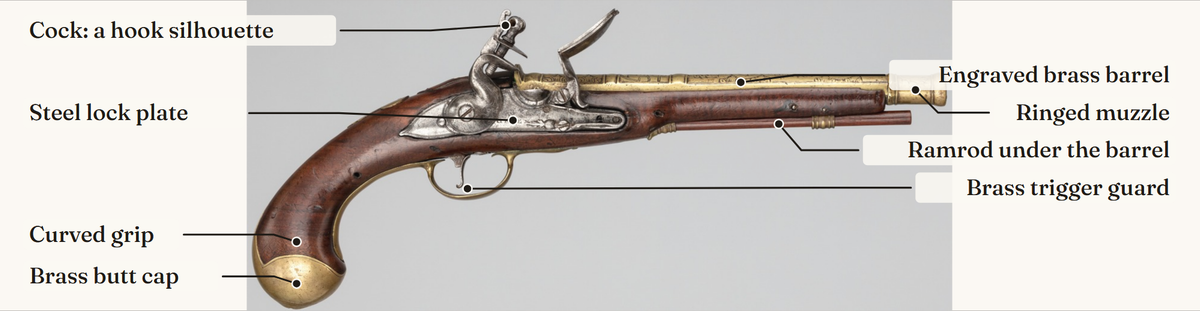
The curved grip and brass butt cap make a strong silhouette, the hooked cock adds a distinctive detail at the top, and the mix of wood, steel and engraved brass gives you three materials to play with. When you design a pirate’s signature weapon, design how it’s carried too: tucked in a sash, hung from a baldric or holstered at the hip.
Color: example pirate palettes
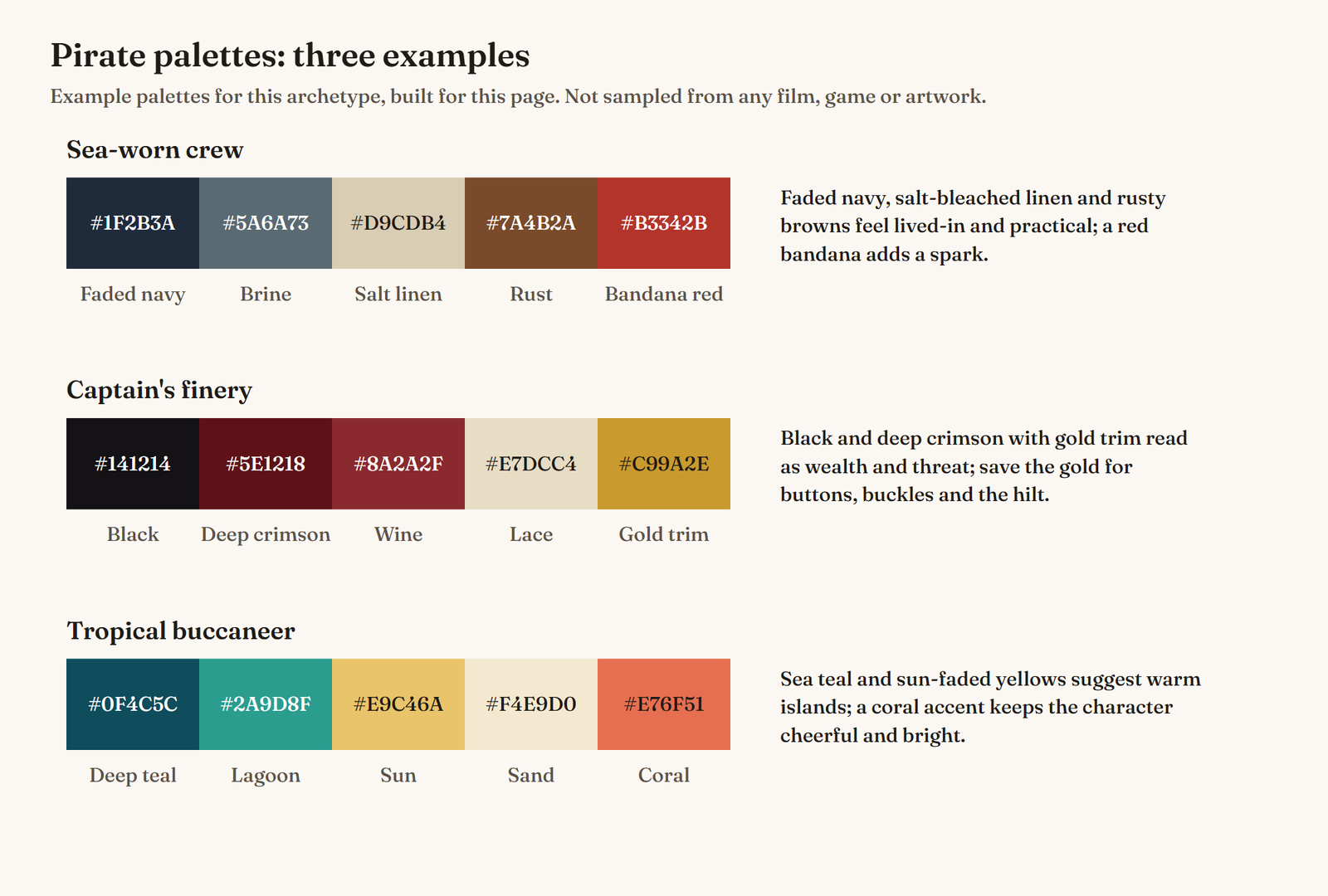
A crew usually shares a faded, sea-worn base (navy, linen, rust) so the ship feels like one place. Captains can break the rule with black, crimson and gold to show wealth and status. A tropical palette of teal, sun yellow and coral suits lighter, adventure-story pirates. Decide which character gets the brightest accent: that’s who the viewer will look at first.
Hats, hair and heads
The head is where pirate silhouettes differ most, so give each character a distinct top shape:
- Tricorn: the classic captain’s hat. Bend one corner, add a feather or a bullet hole, or wear it pushed back.
- Bandana or head wrap: practical for deckhands and fighters, and a great carrier for crew colors.
- Wide-brimmed hat: reads as a navigator, a gentleman pirate or a sun-weary traveler.
- Bare head: braids, a shaved head or wild hair can be more memorable than any hat.
Beards, earrings and scars are details, not shapes. Use them sparingly so they don’t clutter the face.
Designing a pirate crew
A crew is a design system. Start by choosing what everyone shares (a sash color, a tattoo, an emblem stitched on a sleeve or painted on a hat) and then make each role visibly different. The captain gets the most elaborate coat and the biggest hat; the quartermaster looks practical and tough; the gunner carries powder and pistols; the navigator wears tools and charts; the cabin hand wears hand-me-downs that are too big. Line them up in silhouette: if two crew members could be swapped without anyone noticing, change one of them.
Common mistakes in pirate concept art
- The costume-shop pirate. A tricorn, an eye patch and a parrot on every character makes the crew generic. Pick one cliché per character at most.
- Everything new and clean. Pirates live at sea. Show salt stains, patches, mismatched buttons and sun-faded colors.
- No crew identity. Without a shared color or emblem, a crew reads as random people. Repeat one element across everyone.
- Coats that don’t move. A stiff coat kills an action pose. Let the skirts and sash trail the motion.
From pirate concept art to finished artwork
Pirate concept art explores options: hat shapes, coat variations, weapons and callouts explaining how gear is worn. A finished pirate illustration presents one final design in a setting, often on deck or in a port. Most designers work from silhouettes, to a few color roughs, to a design sheet, and only then to a finished piece. Our guide to what a concept artist does explains the process, and our design gallery collects more archetype studies like this one.
Design your own
- Design a pirate captain whose coat tells you how many ships they've taken.
- Design a pirate crew of five that reads as one crew in silhouette, with no two hats alike.
- Turn an 18th-century riding coat into a pirate coat. What do salt, sun and battle do to it?
- Design a pirate who has retired to a tropical island. What do they still wear?
- Design a ghost pirate. Keep the silhouette, but change the materials.
- Design a pirate navigator whose tools are part of the costume.
- Design a signature pistol and the holster or sash that carries it.
- Design a young cabin hand and the captain who took them in, as a matching pair.
- Design a pirate from a cold northern sea instead of the Caribbean.
- Draw eight pirate silhouettes in ten minutes using only hats and coats to tell them apart.