The Basics of Character Design: Process, Principles and Tips
Quick answer
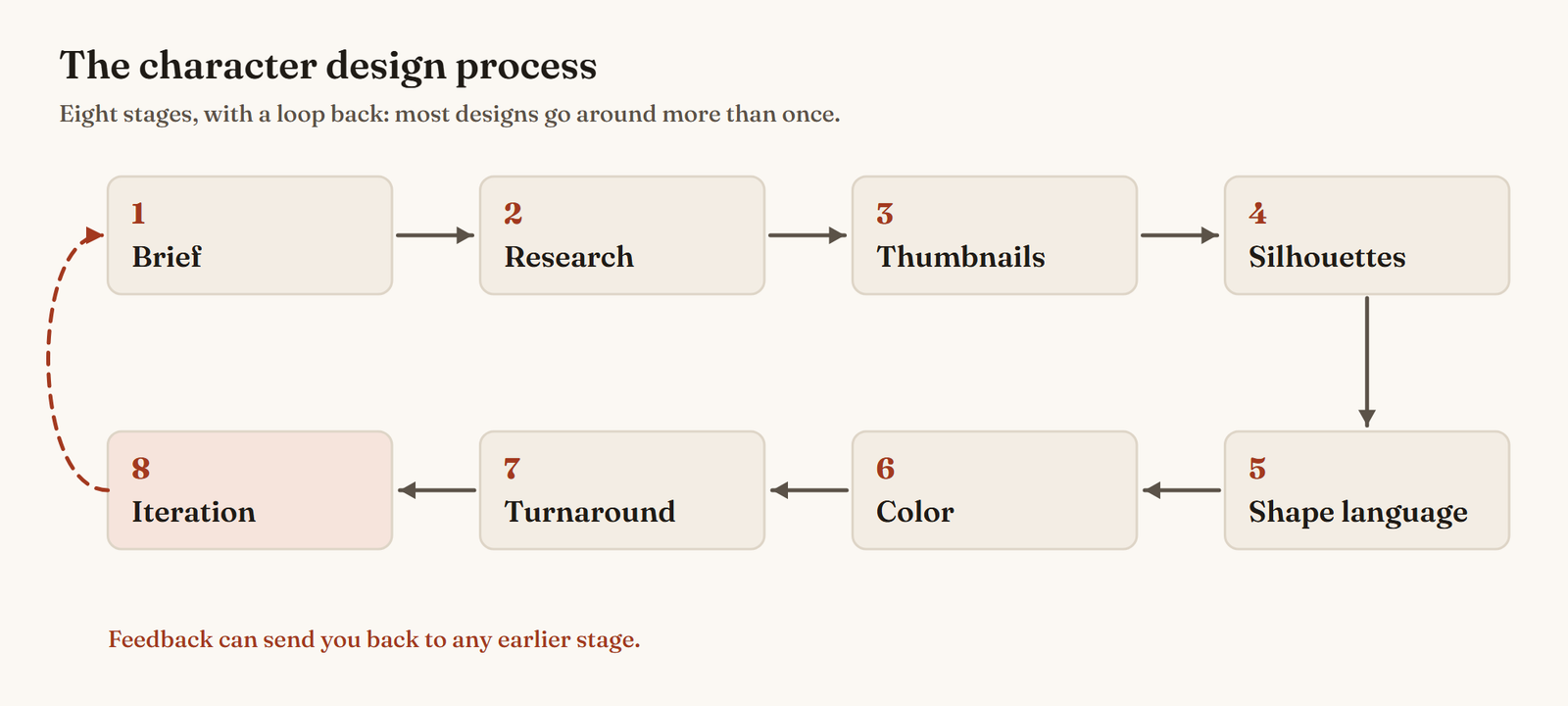
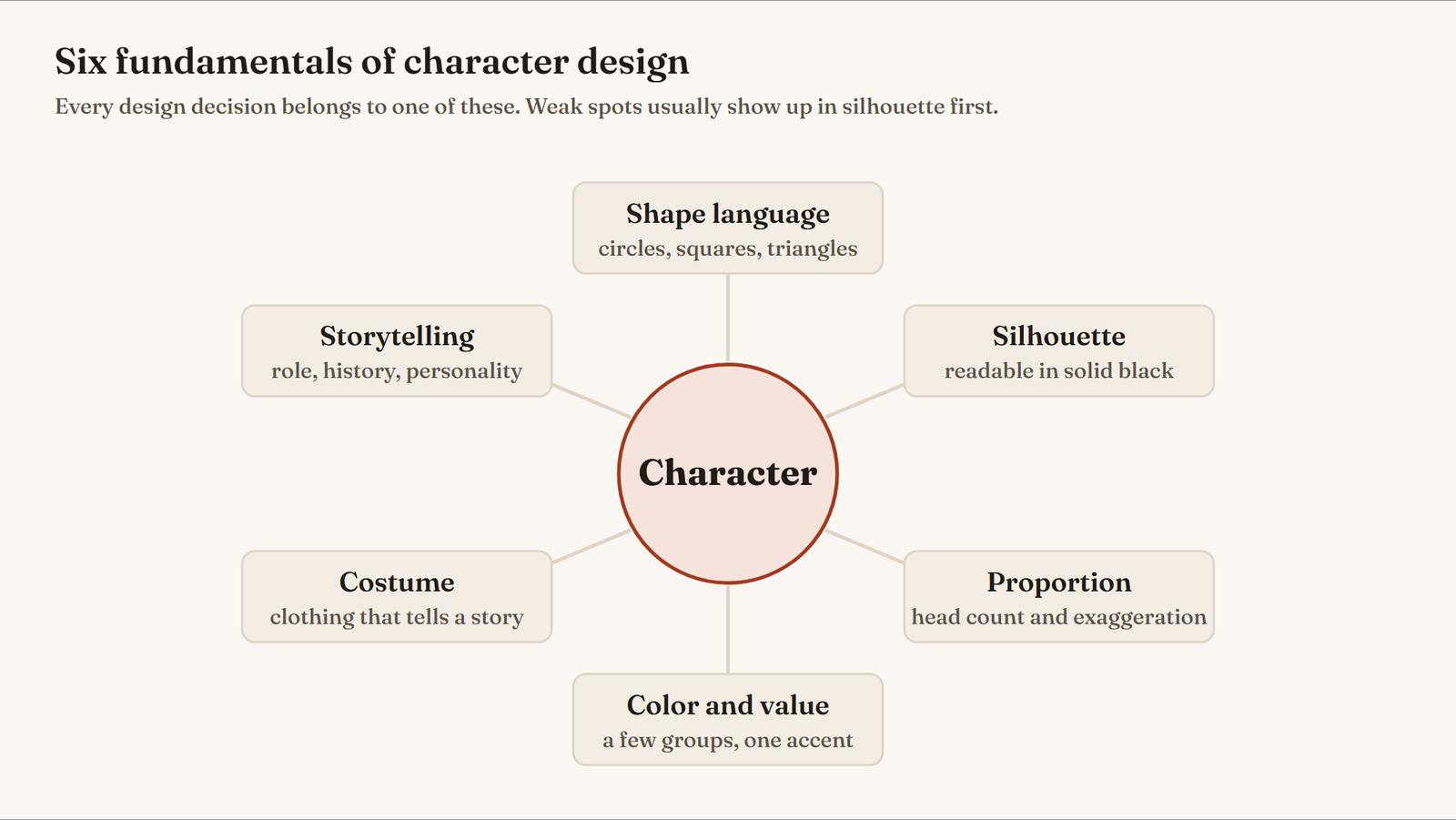
Character design is creating a character's look so it tells the audience who they are at a glance. The basics are a process (brief, research, thumbnails, silhouettes, shape language, color, turnaround, iteration) and six fundamentals: shape language, silhouette, proportion, color and value, costume, and storytelling. Start every design from the story and test it in silhouette.
Character design is the craft of creating a character’s look so that the audience understands who that character is before they say a word. Good designs feel obvious once you see them, but they come from a process and a handful of principles that you can learn. This guide covers the basics of character design: what it is, the process designers follow from brief to final turnaround, the fundamentals that make a design work, and practical tips and exercises.
Every illustration on this page was made for it: diagrams we drew in code and, for the turnaround, 3D renders of our own gray figures. There is no character art by other artists here.
What character design is
Character design is the process of deciding how a character looks: body shape and proportion, face and expression, clothing and props, colors and the details that carry personality and history. Character designers work for animation, games, comics, film and advertising, and the same principles apply across all of them.
A character design is not just a nice drawing of a character. It is a solution to a problem: the story needs a person, creature or robot that an audience can read instantly, remember, and believe in. A good design also has to work in production, which means other artists, animators or modelers can draw or build it the same way every time.
It helps to separate three things that often get mixed up:
- The character: who they are in the story (role, history, personality, goals).
- The design: the visual decisions that express that character.
- The illustration: a finished picture that uses the design.
This guide is about the second: the design decisions. If you are curious how character design fits into wider concept art jobs, our guide to what a concept artist does covers the role.
Types of characters you might design
The same principles apply to every kind of character, but the priorities shift:
- Protagonists need to be appealing and expressive enough to carry a story, and readable from every angle because they appear the most.
- Antagonists often lean on contrast with the hero: different dominant shapes, colors and proportions so the two never blur together.
- Supporting cast should fit the same world but stay distinct in silhouette, so a crowd scene still reads.
- Creatures and robots have no clothing to explain them, so shape language, proportion and silhouette do almost all the work.
- Mascots for brands or products push simplicity furthest: they have to read at tiny sizes and be easy to reproduce.
Character design for animation, games and comics
The basics are shared, but each medium adds its own constraints, and knowing them early saves redesigns.
Animation. Characters are drawn or posed thousands of times, often by many artists. Designs favor clear construction, limited detail and shapes that deform well in motion. Turnarounds, expression sheets and size comparisons with the rest of the cast are standard. Our breakdown of the art of Puss in Boots: The Last Wish looks at how a stylized animated film builds its look.
Games. A character must read from the game camera, which is often far away or behind the character, and against busy environments. Silhouette and value contrast matter even more, and designs are shaped by how they will be modeled, rigged and animated in 3D.
Comics. The same artist often draws the character in every panel, at every size, from every angle, for years. Designs that are fast to draw consistently win. Distinct silhouettes and a few signature features help readers recognize characters in small panels.
Advertising and branding. Mascots and brand characters have to work at tiny sizes, in one color, on packaging and on screen, so simplicity and a strong silhouette come first.
The character design process
Studios and freelancers all adapt the process, but most character designing follows the same order: big decisions first, small ones last, with feedback loops along the way. The diagram at the top of this page shows the eight stages below.
1. The brief
Every design starts with a brief: who the character is, what they do in the story, what world they live in, and any practical constraints such as the art style, the medium or the age of the audience. If no one gives you a brief, write your own. Three facts are enough to start: a role (“a smuggler”), a trait (“who is secretly kind”), and a setting (“in a desert port city”).
2. Research
Next, gather reference for everything the brief mentions: clothing, materials, tools, animals, architecture, body types. Research is what makes a design believable. A pilot’s harness, a baker’s apron or a climber’s gear has a logic to it; copying the logic, not the picture, gives your design authority. Collect references in a board and note what each one tells you.
Useful things to collect for a character:
- Function: how real people with this job dress and move, and what they carry.
- Materials: how leather, metal, wool or plastic look when worn, folded or damaged.
- Shapes from nature or objects: an animal, a plant or a machine whose shapes match the personality you want.
- Era and culture: silhouettes, patterns and accessories from the time and place the character belongs to, researched with respect rather than borrowed as decoration.
3. Thumbnails
Thumbnails are small, fast drawings that explore many ideas before you commit to one. Keep them tiny and rough so you can’t get attached to any of them. The goal is quantity: different body shapes, poses, props and costumes for the same brief.
4. Silhouettes
Many designers thumbnail directly in silhouette: solid black shapes with no interior detail. A strong silhouette is recognizable without any lines inside it, which is exactly what a viewer sees at a distance, in motion or in a dark scene.
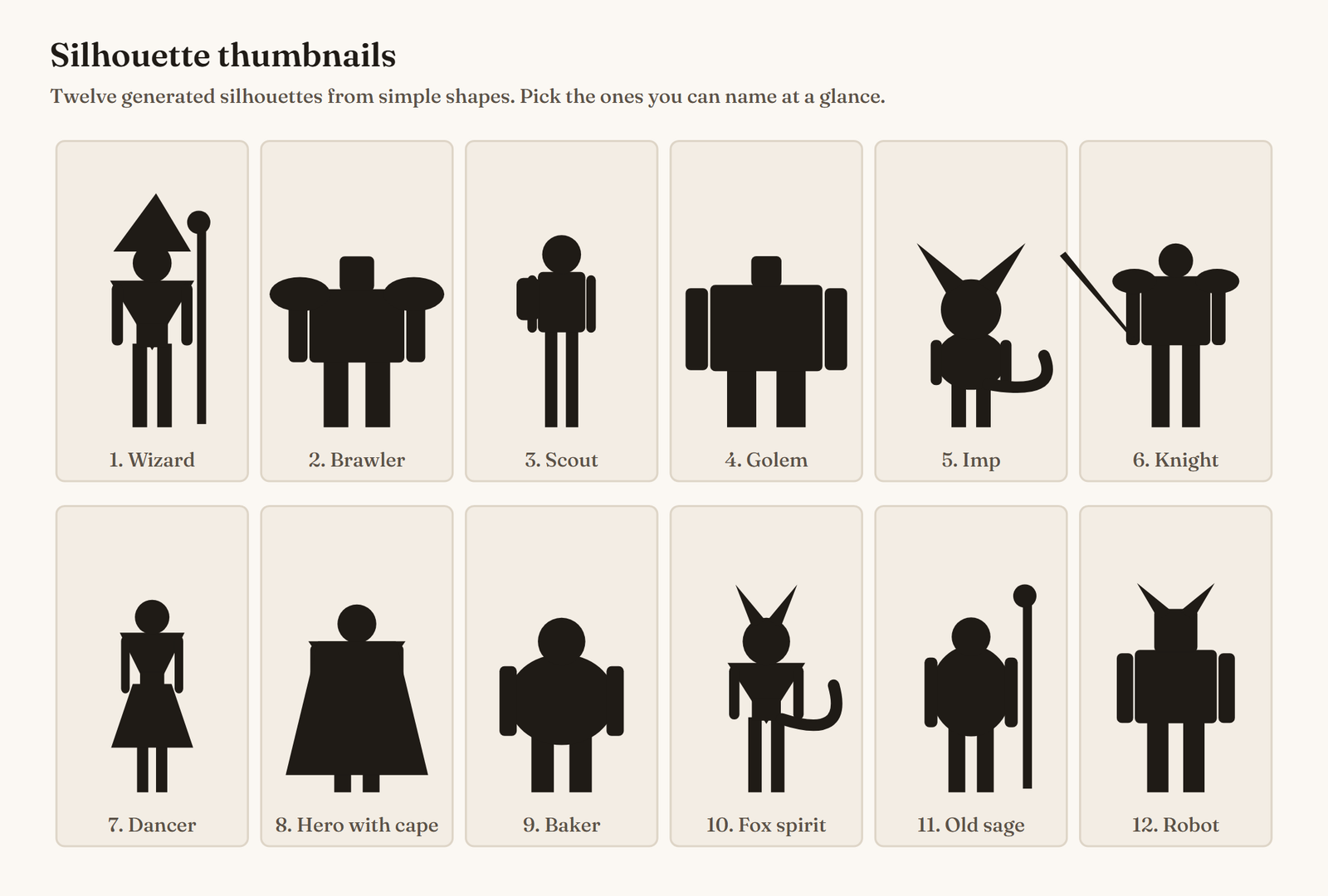
Look at a sheet of silhouettes and pick the ones you can name at a glance. Those are your strongest starting points. Our planned guide to character silhouette design goes deeper.
5. Shape language
With a silhouette chosen, refine its dominant shapes. Round shapes tend to read as friendly and soft, square shapes as stable and strong, triangles as dynamic or dangerous. Most designs mix all three, but one usually dominates. The shape language section below explains how to use it.
6. Color and value
Color comes after shape for a reason: if a design only works because of its colors, it will fall apart in shadow, at a distance or in a black-and-white sketch. Start with values (light, mid and dark areas), then choose colors that support the character and the world.
7. Turnaround
A turnaround (or model sheet) shows the character from several sides, usually front, side and back, often with a three-quarter view. All views sit on shared horizontal guides so the proportions match. It is what lets other artists and modelers reproduce the design.
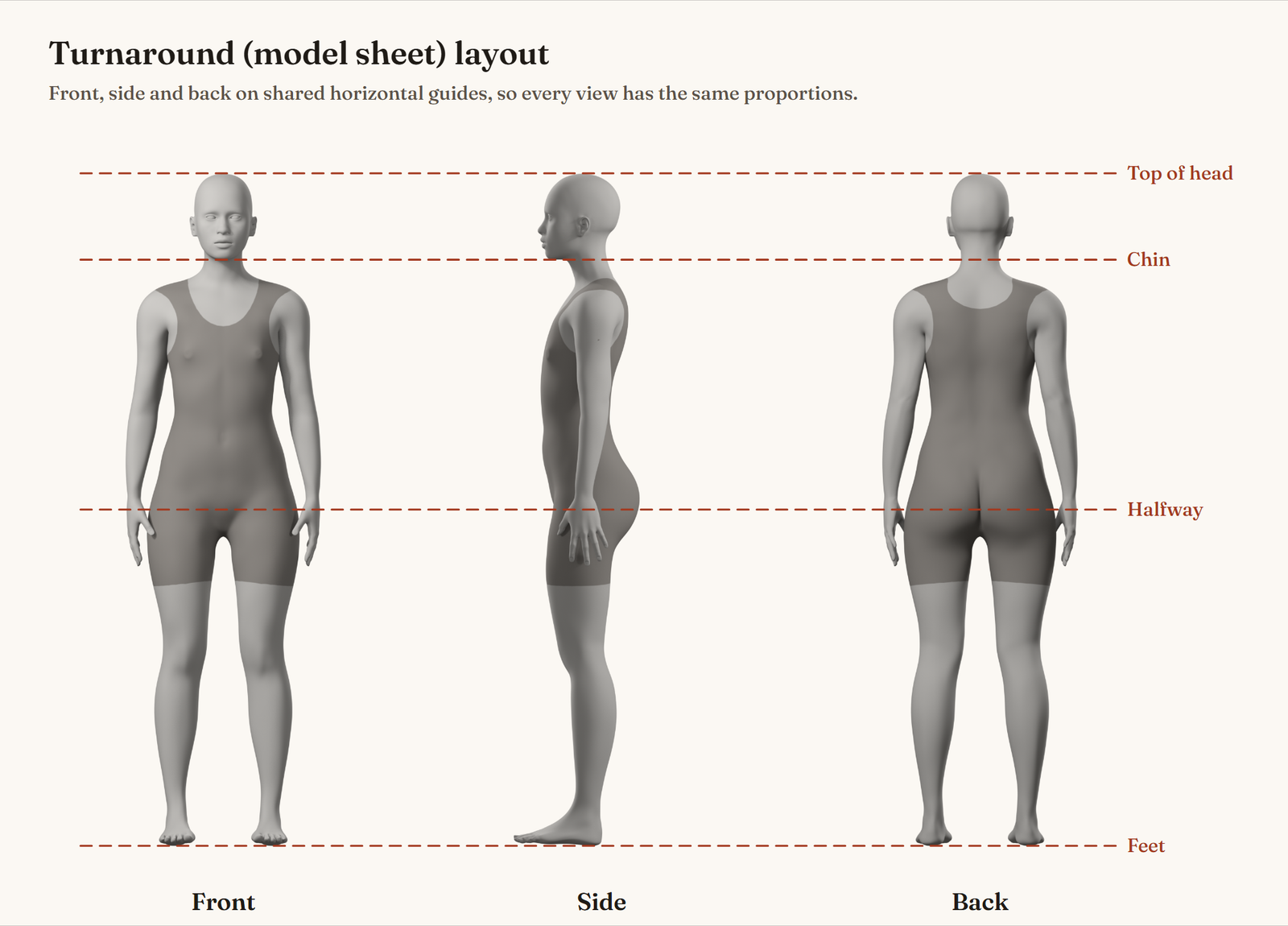
The example above uses our own neutral 3D figure in a plain bodysuit, as a base you could design a costume on. A step-by-step guide to the character turnaround sheet is planned.
8. Iteration
Feedback almost always sends a design back to an earlier stage. A director might ask for a younger feel (back to proportion), a clearer read at small sizes (back to silhouette) or a better fit with the rest of the cast (back to shape language and color). Iteration is not a sign the design failed; it is how designs get good.
Character design fundamentals
The fundamentals of character design are the tools you use at every stage of the process. Each one answers a different question about the character.
Shape language
Shape language is the idea that simple shapes carry associations. It is not a law of nature, and designers break it on purpose, but it is a reliable starting point:
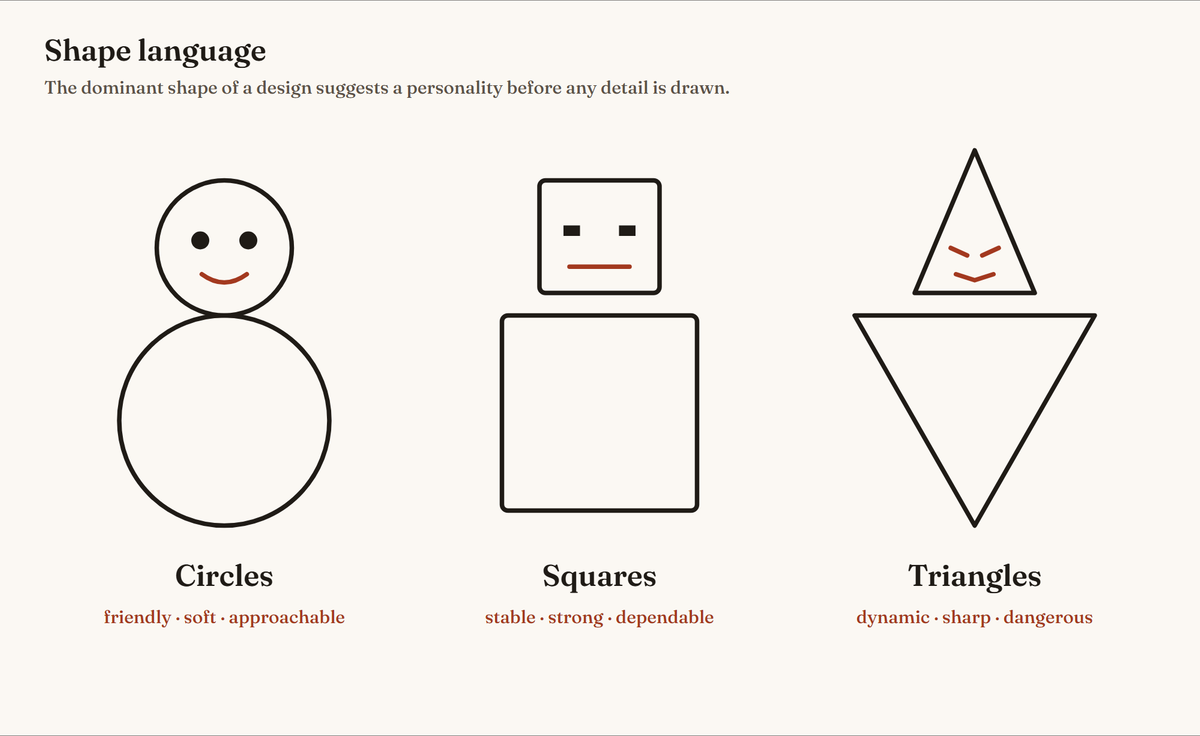
- Circles: soft, friendly, approachable, often young or comic.
- Squares: stable, strong, dependable, sometimes stubborn.
- Triangles: dynamic, sharp, energetic, sometimes threatening.
Contrast makes shape language interesting. A huge, square character with a small round face can read as a gentle giant; a round character with sharp, triangular details can read as cute but dangerous. Our planned guide to shape language in character design has more examples.
Silhouette
The silhouette is the outline of the whole character filled in solid. It is the first thing the eye reads, so it should be distinct within the cast and recognizable without interior lines. Props, hair, hats, capes and stance do most of the work.
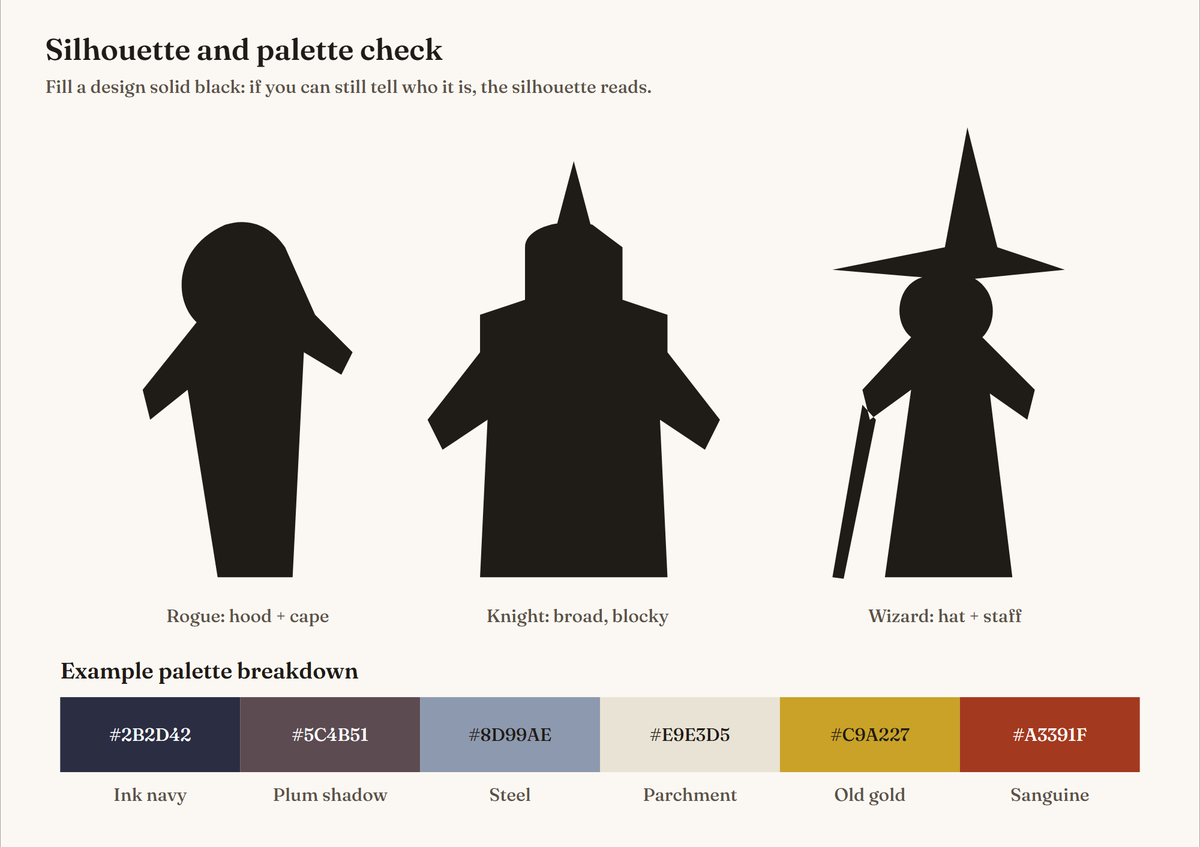
A quick test: fill your design in black and shrink it. If you can still tell who it is, the silhouette works.
Proportion
Proportion, especially the size of the head relative to the body, sets the tone of a design. The more heads tall a character is, the more realistic or heroic it tends to look; the fewer, the younger, cuter or more comic. Proportion also includes the relationships inside the body: long legs, a heavy torso, big hands or a small head all say something.
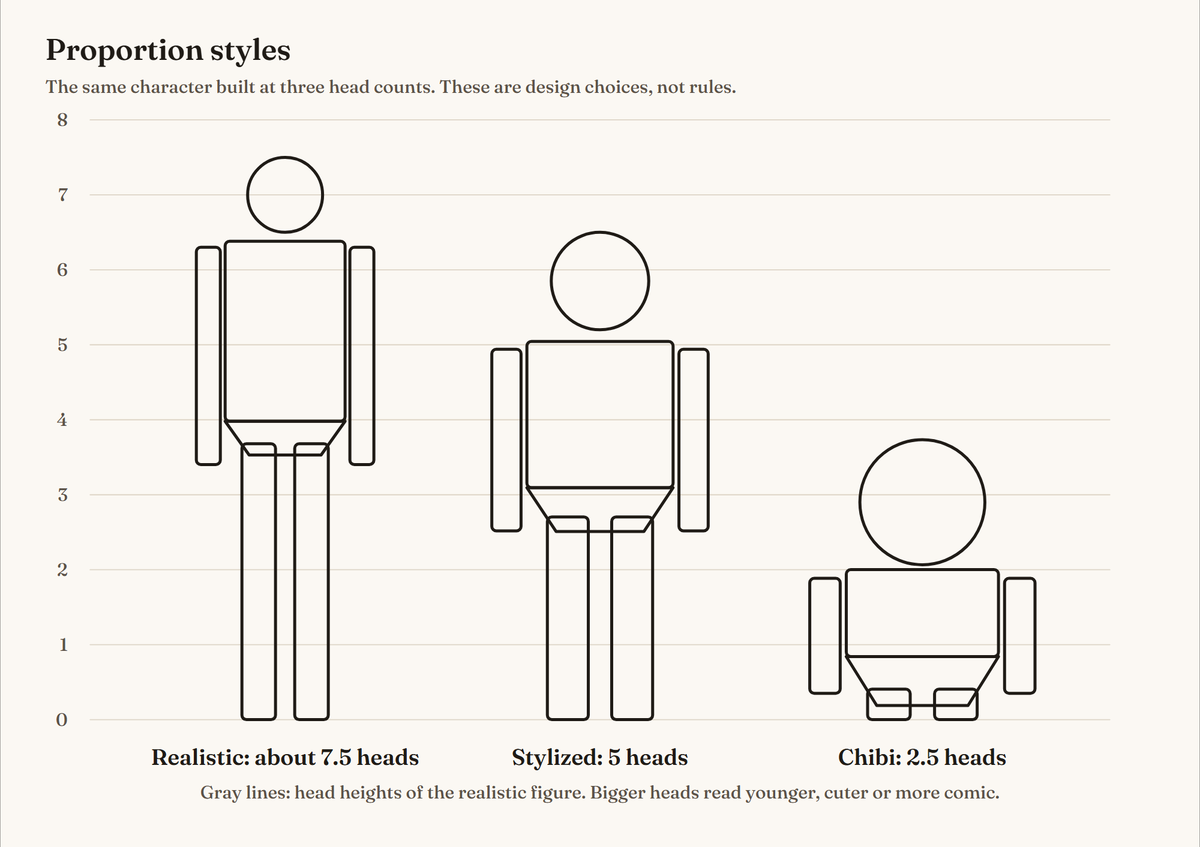
The head counts in the diagram are design choices for this example, not rules. For a realistic base, our figure drawing guide explains how proportions are measured.
Color and value
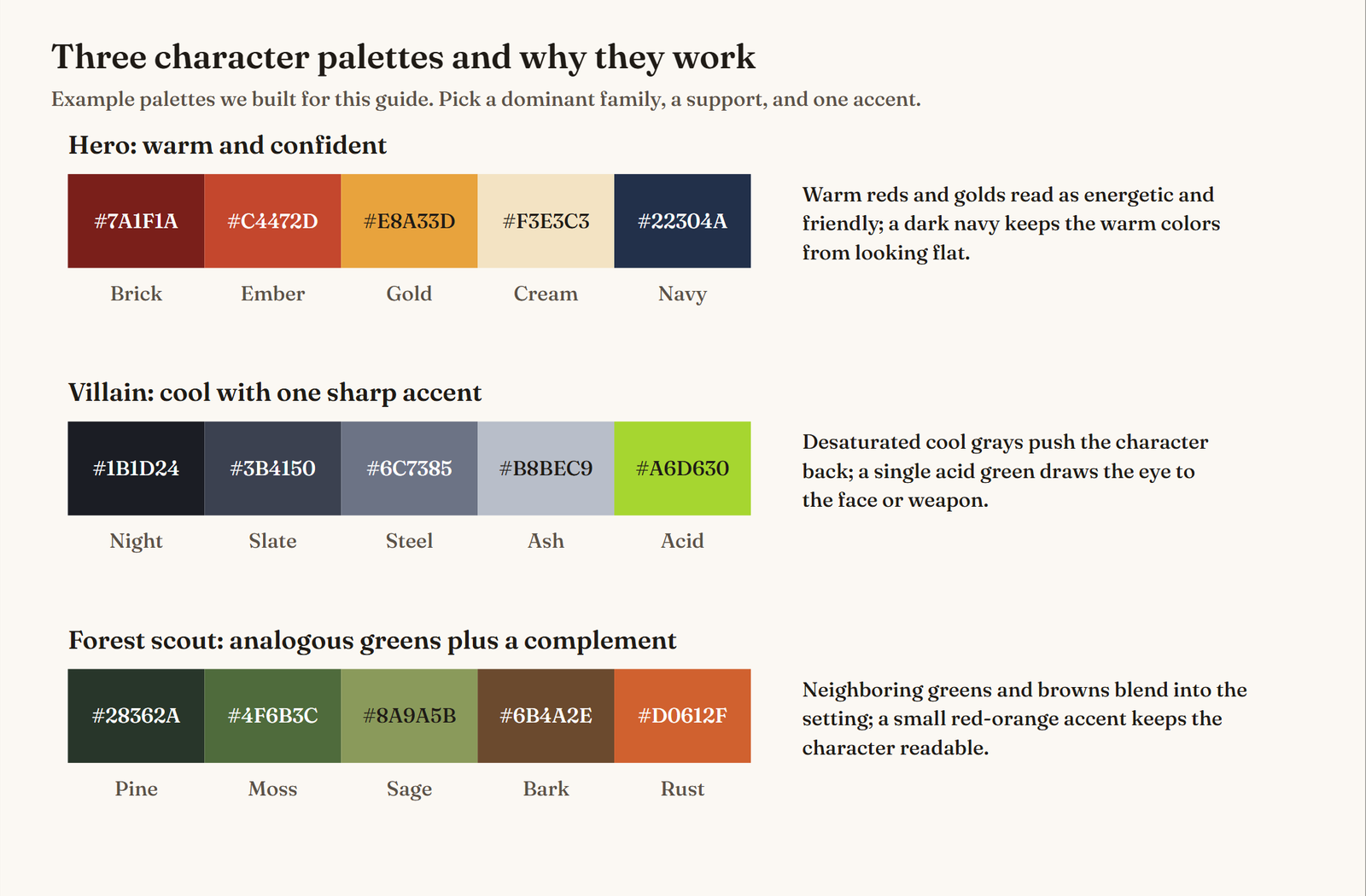
Value (how light or dark an area is) carries a design more than hue does. Group the character into a few clear value areas so the eye knows where to look, usually with the strongest contrast near the face or the character’s most important feature.
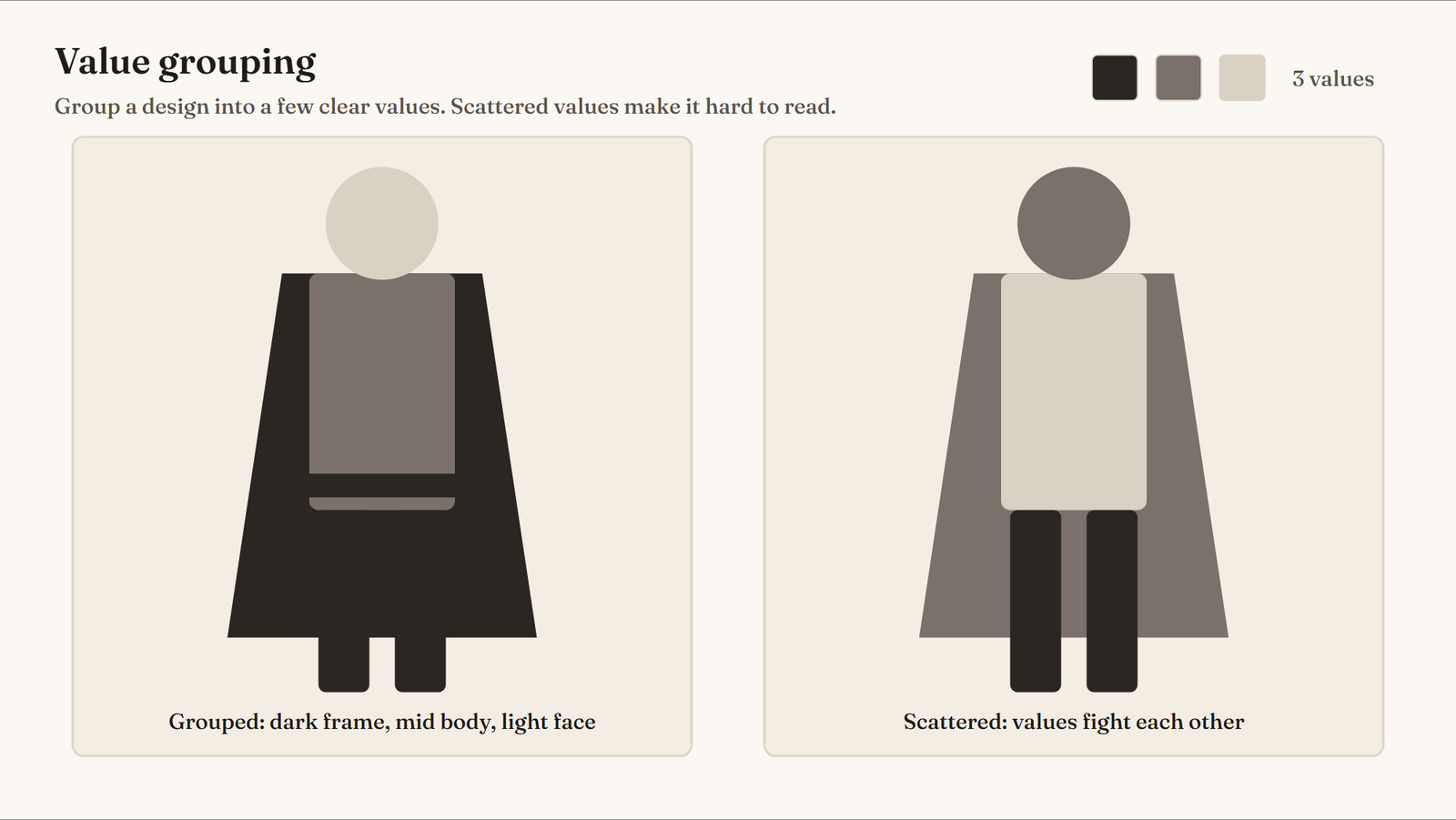
For color, a simple structure works for most characters: a dominant color family, a supporting color and one accent. The palettes below are examples we built for this guide, each with the reasoning behind it.
Our planned guide to character color palettes will collect many more.
Costume
Costume is where much of the storytelling happens. Clothing shows a character’s job, wealth, culture, era and personality, and the way it is worn (patched, spotless, oversized, borrowed) adds history. Design costume from the inside out: what does the character need to carry, protect or show off? Then simplify until it still reads as a silhouette. Our planned guide to costume design for characters covers this.
Storytelling
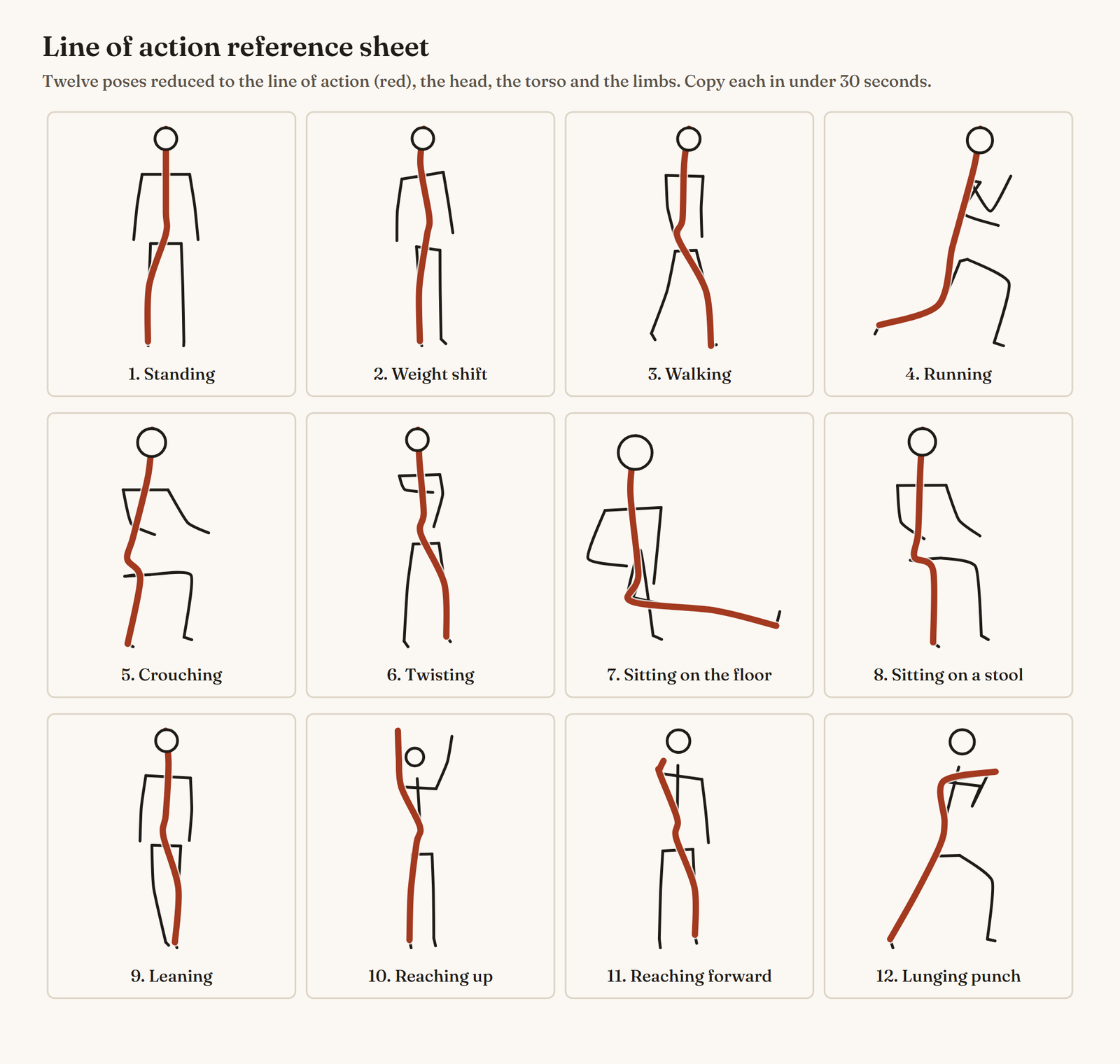
Every visual choice should answer something about the character. Ask of each detail: what does this tell the audience? A scar, a repaired tool, a too-big jacket or a lucky charm is worth including only if it says something true. Pose and expression tell the story too, which is why designers draw characters in action, not just standing straight.
Pose and expression sheets
Once the design is set, designers usually add pose and expression sheets: the character in several typical actions and with a range of facial expressions. They test whether the design holds up in motion and emotion, and they show other artists how the character behaves. A design that looks great standing still but falls apart when it bends, runs or laughs needs another pass. Start these sheets with quick gesture drawings so the attitude comes first and the costume follows.
What makes a good character design
Putting the fundamentals together, a good character design usually has these qualities:
- Readable: recognizable as a silhouette and at small sizes.
- Appealing: pleasant or interesting to look at, which is not the same as pretty; a villain can be appealing.
- Consistent: it can be drawn the same way from every angle and by other artists.
- Expressive: shapes, proportions, colors and costume all point to the same personality.
- Fit for purpose: it suits the style, medium and audience of the project, and is practical to animate, model or print.
A simple character design that meets those five tests is often stronger than a complicated one that doesn’t.
Character design tips
These character design tips apply whether you are designing your first character or your hundredth:
- Exaggerate one thing. A design with one strong feature (huge hands, a tall hat, a long neck) is more memorable than one where everything is average.
- Vary big, medium and small shapes. Rhythm between large masses, medium forms and small details keeps a design interesting and readable.
- Leave rest areas. Not every surface needs detail. Quiet areas make the detailed ones count.
- Design the cast together. Characters who appear together should contrast in silhouette, shape language and color.
- Draw the character doing things. A design that only works standing still isn’t finished. Pose it running, sitting and reacting.
- Keep a design brief visible. Put the three character facts at the top of your page and check every choice against them.
- Sleep on it. Look at your designs the next day; the weak ones become obvious.
How to practice character design
Character design improves with two kinds of practice: drawing skill and design thinking.
Drawing skill. You need to draw believable figures in different poses and from different angles. Gesture and figure drawing are the foundation: our figure drawing guide gives a step-by-step path, and the best gesture drawing sites list free timed reference for daily practice.
Design thinking. Practice making choices for a brief:
- Daily briefs. Write a one-line brief and do a page of silhouettes for it. Our planned list of character design prompts will give you ideas.
- Redesigns. Take a familiar archetype (a knight, a detective, a chef) and redesign it for a different world or era.
- Constraints. Design with only circles, or only three values, or a fixed palette. Constraints force inventive solutions.
- Creatures. Designing animals and creatures trains shape language and silhouette without the crutch of clothing; see our planned guide to creature design.
Traditional or digital? Either works for learning the basics. Paper and a marker are ideal for fast silhouettes and thumbnails because they stop you from fiddling. Digital tools make it easy to flip a design horizontally to check its balance, try color variations on separate layers and build turnarounds on shared guides. Many designers thumbnail on paper and refine digitally. What matters more than the tool is the volume of designs you finish: dozens of quick, complete attempts teach more than one polished drawing.
Keep your pages. Comparing this month’s silhouettes with last month’s is the clearest way to see your design sense improving.
How to become a character designer
Character designers usually build skills in drawing, anatomy and figure drawing, then develop a portfolio of character work that shows their process: silhouettes, iterations, turnarounds and finished designs, not just polished illustrations. Many work in animation, games, comics or advertising, either in-house or as freelancers, and character design is often one part of a wider concept art role.
The practical path is the same as for other concept art jobs: strong fundamentals, a focused portfolio, and finished projects that show you can take a design from brief to turnaround. Our planned guide on how to become a concept artist covers skills, portfolios and the path into the industry.
Common mistakes
- Starting with details: the face, the buttons, the pattern on the sleeve.
- Fix: Start with silhouettes and big shapes. Details only matter once the overall design reads.
- Designing a look with no story behind it.
- Fix: Write three facts about the character first (role, history, personality) and make each visual choice serve one of them.
- Using every color at full strength.
- Fix: Pick a dominant color family, a support color and one accent, and group values into a few clear areas.
- Making the hero, the sidekick and the villain the same build.
- Fix: Vary shape language and proportion across a cast so each character reads differently in silhouette.
- Stopping after the first idea.
- Fix: Do many thumbnails and keep iterating. The first idea is rarely the strongest.
Practice exercise
Twelve silhouettes in twenty minutes
- Write a one-line brief, for example: 'a nervous apprentice who repairs flying machines.'
- Fill twelve small boxes with solid black silhouettes, about a minute and a half each. Vary the dominant shape, the proportion and one prop.
- Without labels, show the sheet to someone (or look at it the next day) and see which silhouettes still read as the brief.
- Pick the best two and redraw them larger with simple shape language and three values.
Frequently asked questions
What is character design?
Character design is the process of creating the look of a character for a story, game, animation or brand, so that the audience understands who the character is at a glance. It covers body shape, proportion, costume, color and the details that show personality and role.
What makes a good character design?
A good character design is readable (it works as a silhouette), consistent (it can be drawn the same way from every angle), and expressive (its shapes, colors and costume tell you something true about the character). It also fits the style and purpose of the project.
What is the character design process?
A common process runs from the brief and research, through thumbnails and silhouettes, to shape language, color and a turnaround, then back through iteration after feedback. Each studio adapts it, but the order from big decisions to small ones stays the same.
How do you practice character design?
Give yourself short briefs and design to them: many silhouettes first, then shape language, values and color for the best one. Draw figures and gesture regularly, and redesign existing characters as exercises to see how small changes affect the read.
Do you need to draw well to design characters?
You need to draw well enough to communicate a design: clear silhouettes, believable poses and consistent views. Figure drawing and gesture practice help a lot, but the core skill is making choices that serve the story.