Oil Painting vs Watercolor: Which Should You Learn First?
Part of The Best Drawing Supplies: What Artists Actually Need
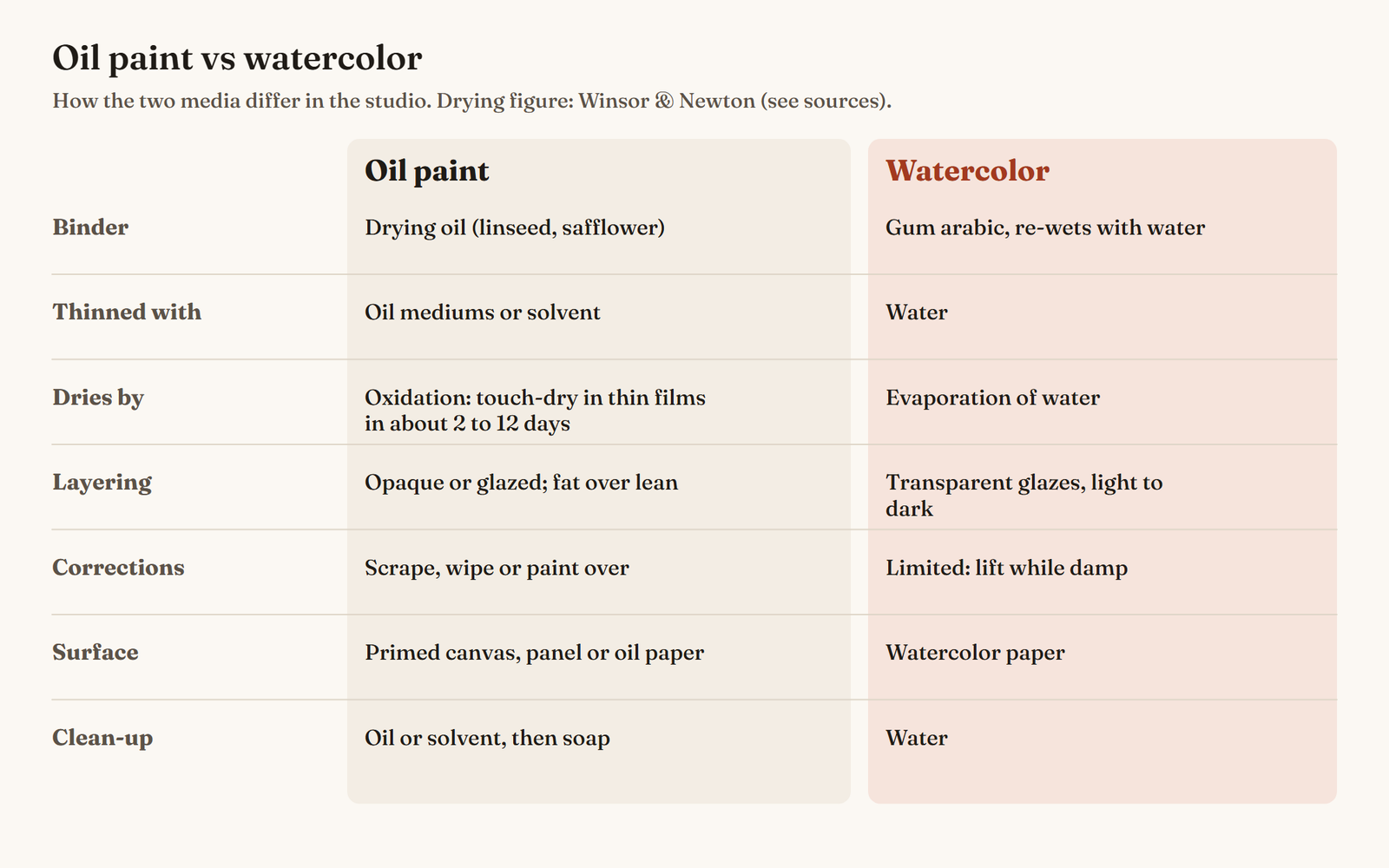
Oil paint vs Watercolor at a glance
| Oil paint | Watercolor | |
|---|---|---|
| What it is | Pigment in a drying oil such as linseed or safflower | Pigment in a water-soluble binder (gum arabic) |
| Thinned and cleaned with | Oil mediums or solvent; solvent-free options exist | Water |
| Drying time | Slow: touch-dry in thin films in about 2 to 12 days (Winsor & Newton) | Fast: dries as the water evaporates |
| Layering | Opaque or glazed; follow fat over lean | Transparent glazes, light to dark |
| Corrections | Easy: scrape, wipe or paint over | Hard: lift some color while damp; whites are the paper |
| Surface | Primed canvas, panel or oil painting paper | Watercolor paper |
| Cost to start | $$ (more items to buy) | $ (a small set, a brush, paper) |
| Space and safety | Ventilation matters if you use solvent | Kitchen-table friendly |
Choose Oil paint if…
- You want to paint slowly, blend on the canvas and rework areas over several sessions.
- You like opaque, rich color and building thick texture.
- You have space for a setup that can stay out while paintings dry.
Choose Watercolor if…
- You want a small, cheap, portable kit to start right away.
- You like light, transparent color and quick studies, sketchbooks and travel painting.
- You draw already and want to add color to your drawings.
Oil painting vs watercolor is one of the first choices a new painter makes. Both use the same kinds of pigments; Gamblin, an oil paint maker, notes that the pigments in oil colors are the same ones found in watercolors. The difference is the binder, and that changes everything else: how the paint dries, how you build a picture, how you fix mistakes, what you need to buy, and how you set up your space. This guide compares oil vs watercolor point by point, then helps you decide which to learn first.
The table and boxes above give the short answer. The sections below explain each difference.
Oil paint in detail
Oil paint is pigment ground into a drying oil, usually linseed or safflower. It doesn’t dry by evaporation. Instead, the oil takes in oxygen from the air and slowly hardens, as Gamblin explains in its guide for schools. That slow drying is oil’s defining trait: colors stay workable for a long time, so you can blend on the canvas, push paint around and come back to an area the next day.
Oil is usually painted on a primed surface such as canvas, a wooden panel or paper made for oil painting. It can be used thick and opaque, so light colors can go over dark ones, or thinned into transparent glazes. That flexibility suits portraits, landscapes and large studio paintings alike.
Watercolor in detail
Watercolor is pigment in a water-soluble binder, traditionally gum arabic. You thin it with water, and it dries as the water evaporates, usually while you’re still working. Watercolor is transparent: light passes through the paint and reflects off the white paper, which gives watercolor its glow. It also means the paper is your white. Instead of painting white on top, you leave the paper bare where you want the lightest lights.
Watercolor paint re-wets when water touches it again, even after it dries. That lets you soften edges and lift some color, but it also means new washes can disturb the layers underneath if you scrub. Watercolor is painted on watercolor paper, in a sketchbook, a pad or a block; our guide to the best watercolor sketchbooks compares the options.
Drying time and layering
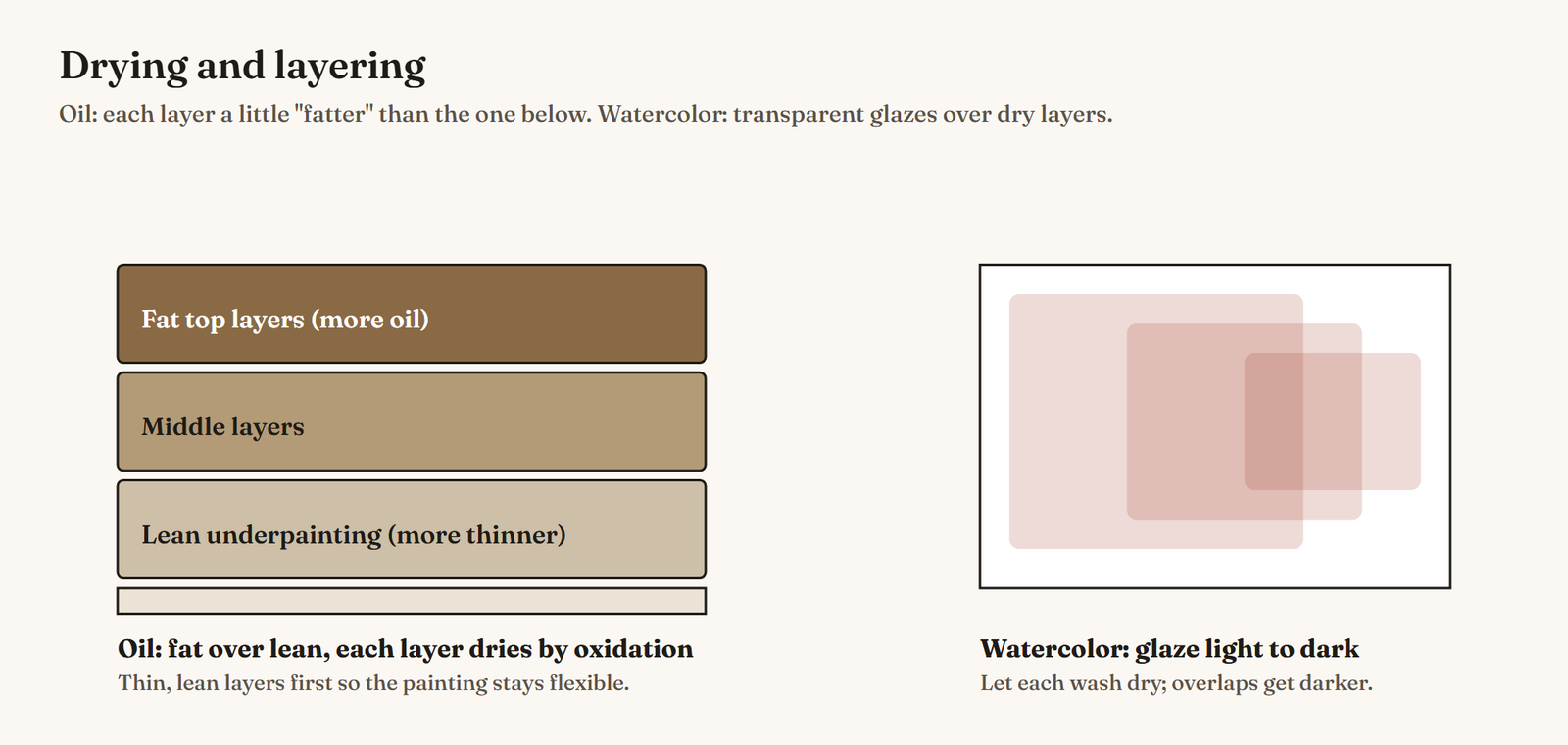
Oil dries slowly. Winsor & Newton states that, as a general rule, its oil colors become touch-dry in thin films in about two to twelve days, depending on the pigment. Thick paint takes longer. When you paint in layers, oil painters follow the fat over lean rule: each layer should contain a little more oil than the one beneath it. Gamblin explains that this keeps the painting flexible so it’s less likely to crack over time. In practice, you start with thin, lean layers (more thinner, less oil) and finish with richer, oilier paint.
Watercolor dries quickly. You build a painting with transparent washes, from light to dark, letting each dry before the next. Overlapping washes get darker, so you plan values in advance. Wet-in-wet (painting into a damp wash) gives soft blends; painting on dry paper gives crisp edges.
The practical result: oil suits slow, considered paintings over several sessions; watercolor suits quick studies, sketchbooks and painting outdoors.
Corrections
Oil is forgiving. You can scrape wet paint off with a palette knife, wipe it back with a rag, or wait for it to dry and paint over it. Because oil is opaque, a light color can cover a dark one.
Watercolor is less forgiving. You can lift some color while it’s damp, or gently re-wet and blot a dry area, but staining pigments won’t come back to white. Most watercolor painters plan their lights first and accept a little unpredictability as part of the medium’s charm.
Cost to start
Watercolor is the cheaper start. A small set of pans, one or two brushes and a pad or sketchbook of watercolor paper is enough. Everything fits in a bag, and cleaning up needs only water.
Oil needs more: tubes of paint, several brushes, a palette and palette knife, a medium, a way to clean brushes (solvent or a solvent-free method), rags, and primed surfaces to paint on. You also need somewhere for wet paintings to dry undisturbed. We use rough tiers rather than prices because prices change: watercolor is a $ start, oil a $$ start. Our guide to drawing supplies covers the drawing basics that both media build on.
Health and safety
Neither medium is dangerous when used sensibly, but they need different precautions.
Oil and solvents. The drying oils in oil paint are not the main concern; Gamblin notes that oils dry by taking in oxygen rather than by evaporating. Solvents are different. Gamblin’s guide for schools states that a solvent’s safety depends on its evaporation rate, its permissible exposure level and the ventilation in the workspace. So if you use solvent:
- Work in a well-ventilated room. Gamblin’s studio safety guide suggests opening windows and putting a fan in one window to blow air out.
- Keep solvent containers closed when you’re not using them, and use only as much as you need.
- Consider solvent-free painting. Gamblin, for example, sells solvent-free mediums and describes cleaning brushes during a session with a drying oil such as safflower oil instead of solvent.
Pigments in both media. The same pigments appear in oil and watercolor, so the same habits apply to both: don’t eat or drink while painting, don’t point brushes with your lips, and wash your hands afterward. Gamblin also advises a NIOSH dust respirator if you sand surfaces with a high percentage of cadmium colors or handle cadmium as dry pigment.
Do you use water with oil paints?
Not with traditional oil paint. Oil and water don’t mix, so water won’t thin oil paint or clean it from brushes. That’s the main practical difference between oil paint vs water-based paints like watercolor, gouache and acrylic.
There is an exception: water-mixable (water-miscible) oil paints, designed to be thinned and cleaned up with water. Opinions differ. Gamblin’s guide states that, after its own testing, it believes water-miscible oils involve too much artistic compromise for no real gain in safety, and it recommends traditional oils used with its low-odor and solvent-free methods instead.
Can you use oil paint on watercolor paper?
You can, but not on bare paper. Raw watercolor paper absorbs the oil, which can leave a halo around strokes and, over time, weaken the paper fibers. For oil on watercolor paper, prime the sheet first with acrylic gesso, or use paper made specifically for oil painting. Watercolor paper is for water-based media; oil wants a sealed or primed surface.
Which should you learn first?
For most beginners, especially people who already draw, watercolor is the easier place to start: it’s cheaper, smaller, quicker to set up and quicker to clean. A watercolor sketchbook lets you paint a little every day, and the habit of planning lights and values carries over to any medium.
Choose oil first if you want a medium that forgives mistakes, if you prefer slow, deliberate painting, or if you’re drawn to rich, opaque color and texture. Oil also suits painters who like to work on one picture over several sessions.
Watercolor vs oil painting isn’t a contest, and there’s no wrong choice. Many painters learn both: watercolor in the sketchbook, oil in the studio. Oil and watercolour painting (as it’s spelled in British English) teach complementary skills: watercolor teaches planning and restraint, oil teaches color mixing and form. If you’re also weighing acrylic, our planned comparisons of acrylic vs oil paint and watercolor vs gouache will cover those choices.
Using watercolor and oil together
Watercolor and oil can work together in one practice, if not on one surface. Many oil painters make small watercolor studies outdoors to record color and light, then paint larger oil versions in the studio. Others use a watercolor sketchbook to plan compositions before committing to canvas. Keep the two on separate surfaces: watercolor on paper, oil on a primed surface.
Frequently asked questions
Is oil painting harder than watercolor?
They are hard in different ways. Oil is easier to correct because you can scrape or paint over mistakes, but it needs more materials and patience while layers dry. Watercolor needs little equipment, but it's less forgiving: you plan your lights in advance because the white of the paper is your lightest value.
Do you use water with oil paints?
Not with traditional oil paint, which doesn't mix with water. Oil is thinned with oil mediums or solvent. Water-mixable oils exist and are designed to be thinned with water, though some makers, such as Gamblin, prefer traditional oils used with low-odor or solvent-free methods.
Can you use oil paint on watercolor paper?
Not on bare watercolor paper: the oil soaks into the fibers and can make the paper brittle over time. Use paper made for oil painting, or prime the paper with gesso first.
Should a beginner start with oils or watercolors?
If you want the cheapest, quickest start, watercolor. If you want a forgiving medium you can rework, oil. Many beginners start with watercolor in a sketchbook, then try oils once they enjoy painting.
What is one of the advantages of oil paint?
One of the advantages of oil paint is its slow drying time. Colors stay wet long enough to blend smoothly on the canvas and to rework areas, which watercolor doesn't allow.
Sources
- Understanding drying times for oil colour, Winsor & Newton. Accessed .
- Fat-Over-Lean, Gamblin Artists Colors. Accessed .
- Oil Painting Guide for Schools (oxidation drying; solvent safety and ventilation; water-miscible oils), Gamblin Artists Colors. Accessed .
- Studio Safety Guide (ventilation; disposal of oily rags; cadmium dust), Gamblin Artists Colors. Accessed .
- Solvent-Free Painting, Gamblin Artists Colors. Accessed .