The Best Drawing Supplies: What Artists Actually Need
| Award | Product | Best for | Price | Link |
|---|---|---|---|---|
| Best starter kit | General's Kimberly Graphite Drawing Kit | beginners who want pencils, an eraser and a sharpener in one purchase | Price tier 1 of 3 | Check price |
| Best pencils to grow into | Staedtler Mars Lumograph 100 | artists who want one consistent brand from light to dark | Price tier 2 of 3 | Check price |
| Best plastic eraser | Staedtler Mars plastic 526 50 | clean, complete erasing of graphite lines | Price tier 1 of 3 | Check price |
| Best kneaded eraser | Faber-Castell Art Eraser (kneadable) | lifting and lightening tone without rubbing the paper | Price tier 1 of 3 | Check price |
| Best simple sharpener | Staedtler 510 10 metal sharpener | a reliable point on standard drawing pencils | Price tier 1 of 3 | Check price |
| Best sketch paper | Strathmore 400 Series Sketch | everyday pencil and charcoal sketching | Price tier 1 of 3 | Check price |
| Best charcoal to start with | General's Charcoal Pencil | figure drawing and bold value studies | Price tier 1 of 3 | Check price |
| Best ink pens | Staedtler pigment liner 308 | inking over pencil and ink-and-wash sketches | Price tier 2 of 3 | Check price |
| Best digital starter | Wacom Intuos | trying digital drawing on a computer you already own | Price tier 2 of 3 | Check price |
Our picks
Best starter kit
General's Kimberly Graphite Drawing Kit
Best for: beginners who want pencils, an eraser and a sharpener in one purchase
- Kit contents
- 10 Kimberly pencils (8B to 4H), a plastic eraser and a metal sharpener (source)
Pros
- Covers the essentials in one box
- Low price tier
Cons
- No paper or kneaded eraser included
Best pencils to grow into
Staedtler Mars Lumograph 100
Best for: artists who want one consistent brand from light to dark
- Grade range
- 24 degrees, 12B to 10H (source)
Pros
- Widest stated grade range of the pencils we checked
- Sold singly, so you can buy only the grades you use
Cons
- A full tin is more than a beginner needs
Best plastic eraser
Staedtler Mars plastic 526 50
Best for: clean, complete erasing of graphite lines
- Size
- 65 x 23 x 13 mm (source)
- Maker's description
- Premium quality, minimal crumbling, protective sleeve (source)
Pros
- Erases cleanly with little crumbling, as the maker describes
- Sleeve keeps it clean
Cons
- Too blunt for tiny highlights; cut a corner or use a kneaded eraser
Best kneaded eraser
Faber-Castell Art Eraser (kneadable)
Best for: lifting and lightening tone without rubbing the paper
- Maker's description
- For correcting and lightening charcoal and pastel work; extremely kneadable and absorbent (source)
Pros
- Shapes to a point for small highlights
- Lifts charcoal and graphite gently
Cons
- Colored version; picks up dirt over time like any kneaded eraser
Best simple sharpener
Staedtler 510 10 metal sharpener
Best for: a reliable point on standard drawing pencils
Pros
- Metal body, single hole
- Recommended by Staedtler on its Lumograph page
Cons
- No shavings container
- Too small for jumbo or woodless pencils
Best sketch paper
Strathmore 400 Series Sketch
Best for: everyday pencil and charcoal sketching
- Paper
- 60 lb (89 g/m²), fine tooth (source)
Pros
- Fine tooth that takes graphite and charcoal
- Pads come in many sizes
Cons
- Too light for wet media
Best charcoal to start with
General's Charcoal Pencil
Best for: figure drawing and bold value studies
- Degrees
- HB (hard), 2B (medium), 4B (soft), 6B (extra soft) (source)
Pros
- Clean to hold, unlike stick charcoal
- Four degrees
Cons
- Smudges; needs fixative
Best ink pens
Staedtler pigment liner 308
Best for: inking over pencil and ink-and-wash sketches
- Line widths in the set
- 0.05, 0.1, 0.3, 0.5, 0.7, 1.0, 1.2 and a 0.3–2.0 chisel (source)
- Ink
- Pigment ink, lightfast, waterproof on paper (source)
Pros
- Seven line widths plus a chisel tip
- Waterproof once dry, so you can add watercolor
Cons
- Fine tips wear quickly if pressed hard
Best digital starter
Wacom Intuos
Best for: trying digital drawing on a computer you already own
- Pen pressure
- 4K pressure levels (source)
- Versions
- Intuos S, Intuos S with Bluetooth, Intuos M with Bluetooth (source)
Pros
- Lowest-commitment way into digital drawing
- Bluetooth versions available
Cons
- You draw on the tablet while looking at the screen, which takes practice
The best drawing supplies are fewer than most shopping lists suggest. Good drawing supplies come down to a handful of pencils, two erasers, a sharpener and paper that suits what you draw. Everything else (charcoal, ink, blending tools, a tablet) is something to add when you need it. This guide sorts recommended art supplies into what to buy first and what to add next, by budget and by medium, with one checked pick per category and links to our detailed roundups.
Every product on this page is still listed on its maker’s website, and every spec comes from that page, checked in November 2026. We don’t show product photos; the checklist and diagrams are our own.
What you actually need: the starter checklist
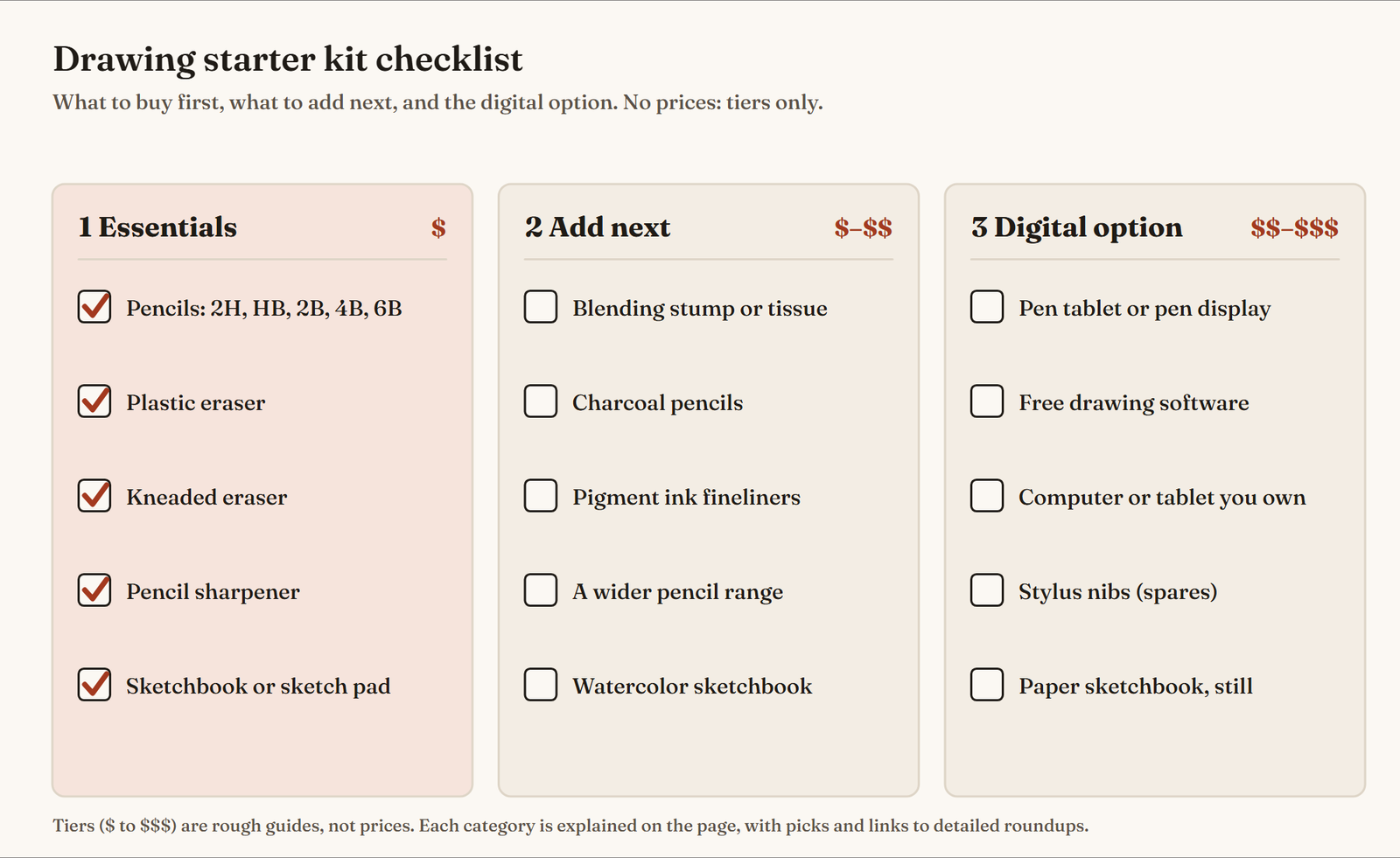
The checklist at the top of this page is the short version. As a drawing utensils list, the essentials are:
- Pencils: 2H, HB, 2B, 4B and 6B.
- A plastic eraser for clean erasing.
- A kneaded eraser for lifting and lightening tone.
- A sharpener (or a craft knife and sandpaper).
- A sketchbook or sketch pad.
That’s everything a beginner needs for months. Roundups of new art supplies 2024 and later releases come and go, but these essentials don’t change. Our planned printable art supplies list for beginners will turn this into a checklist you can take to the store.
Kits by budget
You can build a good kit at any budget. These tiers are rough guides, not prices:
- $ (cheap drawing supplies): a beginner pencil kit such as General’s Kimberly Graphite Drawing Kit, a sketch pad, a kneaded eraser. Enough to learn the basics.
- $$ (step-up kit): single pencils from a professional range in the grades you use, a plastic and a kneaded eraser, a metal sharpener, a heavier sketchbook, a few pigment liners and a charcoal pencil.
- $$$ (professional drawing supplies): a full pencil range, cotton paper for finished work, a wider set of erasers and blending tools, and perhaps a pen tablet or display for digital work.
A ready-made drawing set is convenient for beginners and for gifts. The best drawing set for beginners is small and sensible: a few grades, an eraser and a sharpener, not 40 pieces you’ll never use. Our planned guide to the best drawing kits for beginners will compare them. The same advice holds for the best art supplies for adults who are starting out: buy the essentials, draw a lot, then upgrade.
Pencils
Pencils are graded from hard (H, light lines) to soft (B, dark tone), with HB in the middle. Five grades from 2H to 6B cover almost everything you’ll draw at first.
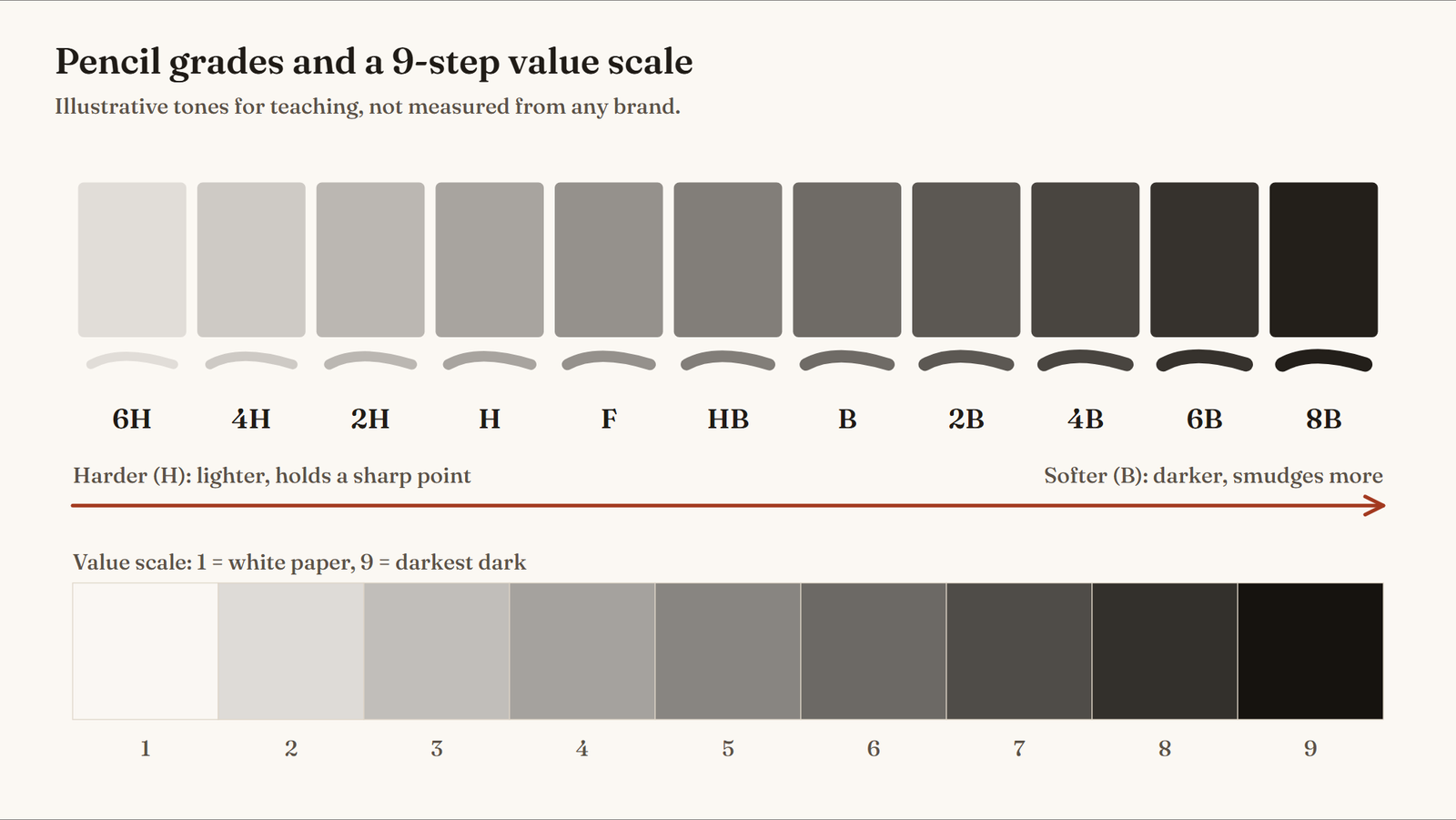
Good drawing utensils start with consistent pencils. A kit gets you started; single pencils from a professional range let you replace only the grades you use. Our full roundup of the best pencils for drawing compares nine pencils and their grade ranges, and our planned guides cover mechanical pencils and colored pencils.
Erasers
You need two:
- A plastic (vinyl) eraser removes graphite cleanly. It’s for mistakes and clean edges.
- A kneaded eraser is soft and shapeable. Press it onto the drawing to lift tone, or shape it to a point for highlights. It’s essential for charcoal.
Some artists add an eraser pencil or a precision eraser for tiny highlights. Our planned guide to the best erasers for drawing will cover them in detail.
Sharpeners and other drawing accessories
A simple metal sharpener keeps standard pencils sharp. Many artists prefer a craft knife and a sanding pad, which give a longer, exposed lead for shading with the side of the pencil. Other useful drawing accessories:
- Blending stumps or tortillons (tightly rolled paper) for smooth tone. A tissue or cotton swab works too.
- A drawing board and clips so you can work at an angle.
- Workable fixative to stop charcoal and soft graphite smudging.
- A ruler for perspective and layout work.
None of these is essential on day one. The best drawing utensils are the ones you use every day (our guide on how to draw every day helps with the habit); accessories are for when a specific problem appears.
Paper and sketchbooks
Paper matters more than most beginners expect. For pencil and charcoal sketching, a sketch paper with a fine tooth (a slight texture) holds graphite well. Strathmore’s 400 Series Sketch, for example, is a 60 lb (89 g/m²) fine-tooth paper, as the maker states. For the best sketch supplies, pair a pad like this for practice with a bound sketchbook you carry everywhere.
For wet media you need heavier paper. Our guide to the best watercolor sketchbooks compares eight books and blocks by paper weight, cotton content and binding, and our planned guide to the best sketchbooks for drawing will cover dry media.
Charcoal
Charcoal gives darker, more matte blacks than graphite and encourages big, loose drawing, which suits life drawing and quick figure studies. Charcoal pencils are the cleanest way to start; vine and compressed charcoal sticks come next. Use a kneaded eraser to lift highlights and spray fixative when you’re done. Our planned guide to the best charcoal for drawing will compare the types, and our figure drawing guide shows charcoal at work.
Ink pens
Pigment-ink fineliners are the easiest way to start inking. Pigment ink is waterproof once dry on most papers, so you can add watercolor over it. A set with several line widths lets you vary line weight: fine for detail and texture, thicker for outlines. Comic artists add brush pens and dip pens later; our planned guide to art supplies for comic artists will cover them.
Painting supplies
If you want to add color, watercolor is the lightest step from drawing: a small paint set, one or two brushes and a watercolor sketchbook. Oil and acrylic need more equipment and space. Our comparison of oil painting and watercolors explains what each needs and which to learn first.
The digital option
A pen tablet connects to a computer you already own; you draw on the tablet and watch the screen. It’s the lowest-commitment way into digital drawing. Pen displays (you draw on the screen) and tablets such as the iPad cost more but feel closer to paper. Free drawing software is enough to start. Our planned guides to drawing tablets for beginners and the iPad for drawing will compare the options. Most digital artists still keep a paper sketchbook for ideas and practice.
Professional upgrades
Top art supplies earn their price in consistency and longevity, not magic. When you’re ready to upgrade, these changes make the biggest difference:
- Paper first: heavier, better-sized paper, and cotton paper for wet media.
- Single professional pencils in the grades you use most.
- Lightfast materials (pigment inks, artist-grade paints) for work you want to keep or sell.
- Books and courses: good instruction improves your drawing faster than new materials. Our roundups of figure drawing books and perspective drawing books are a good place to start.
High quality art supplies are worth it when they solve a problem you actually have. Good quality art supplies you don’t use are just clutter.
Bonus: drawing your art supplies
Art supplies that you can draw make excellent practice subjects: they’re always on your desk, they don’t move, and they’re made of simple shapes. A pencil is a cylinder with a cone, an eraser is a box, a sketchbook is a flat box, and a jar of brushes is a cylinder full of lines.
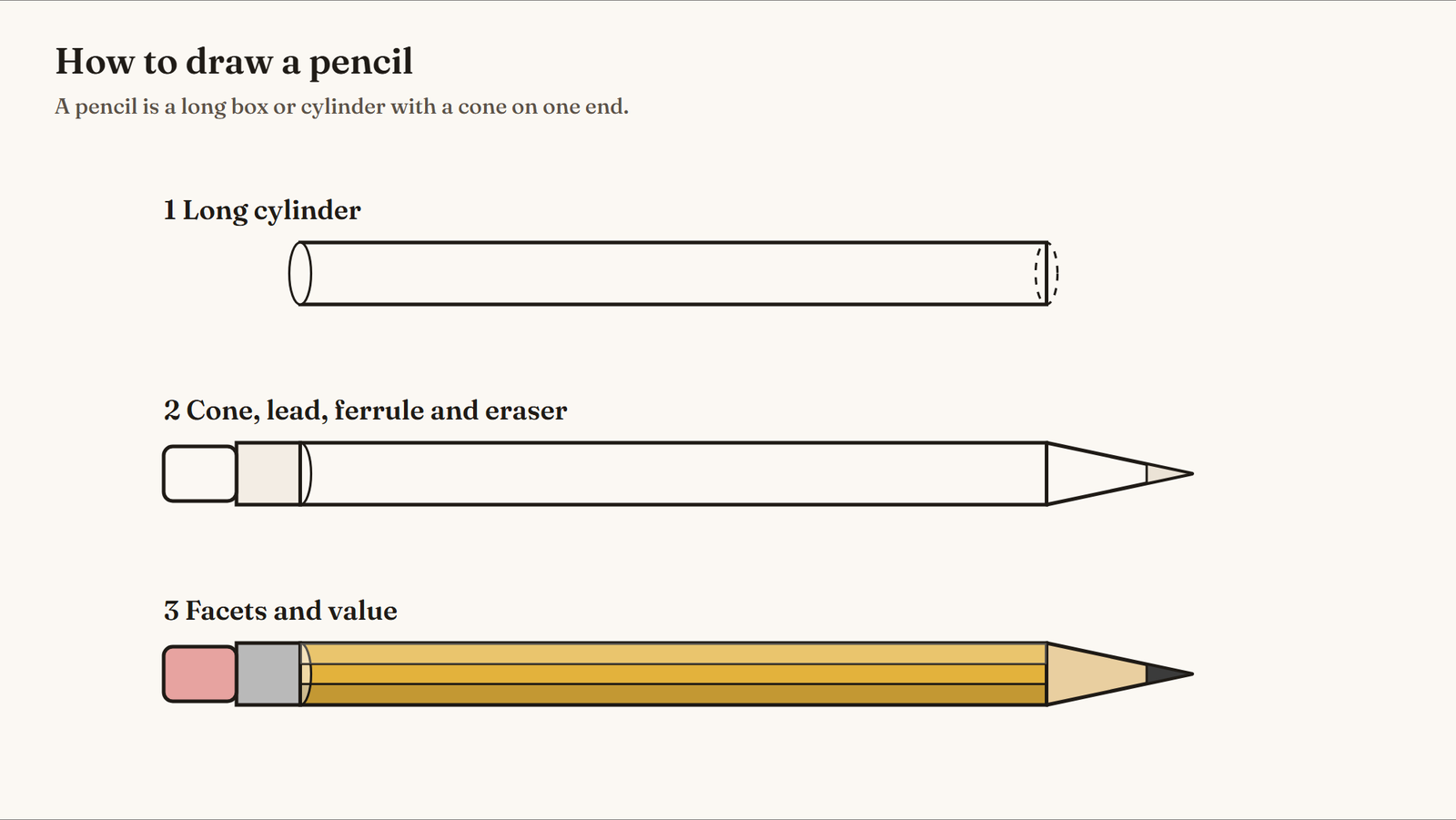
For an easy still life, arrange three or four supplies under a single lamp and draw them in 15 minutes. A drawing of art supplies like this teaches shape, perspective and shading at once, and it uses the very tools on this page.
Frequently asked questions
What drawing supplies does a beginner need?
Five pencils (2H, HB, 2B, 4B, 6B), a plastic eraser, a kneaded eraser, a sharpener and a sketchbook. That's enough for months of practice. Add charcoal, ink or a digital tablet later, when you know what you enjoy.
What are the best cheap drawing supplies?
A pencil kit such as General's Kimberly kit, a plain sketch pad and a kneaded eraser cost little and cover the basics. Spend more on paper before you spend more on pencils; cheap, thin paper is harder to draw on than cheap pencils.
Do professional artists use expensive supplies?
Some do, but most professional drawing supplies are the same basics in better versions: consistent pencils, good erasers and paper that suits the medium. Skill comes from practice, not from the price of the kit.
Should a beginner start with traditional or digital drawing?
Traditional supplies cost less to start and teach line, value and control directly. A pen tablet is a good next step if you want to work digitally; many artists keep a paper sketchbook either way.
What is the difference between a kneaded and a plastic eraser?
A plastic eraser removes graphite cleanly and completely. A kneaded eraser is soft and shapeable; you press it to lift and lighten tone without rubbing, which suits charcoal and soft graphite.
Sources
- Kimberly Graphite Drawing Kit, 12 pieces, General Pencil Company. Accessed .
- Mars Lumograph 100 drawing pencil, STAEDTLER. Accessed .
- Mars plastic 526 50 eraser, STAEDTLER. Accessed .
- Art Eraser kneadable eraser #127321, Faber-Castell. Accessed .
- 510 10 metal sharpener, STAEDTLER. Accessed .
- 400 Series Sketch (60 lb, 89 g/m²), Strathmore. Accessed .
- General's Charcoal Pencil, General Pencil Company. Accessed .
- pigment liner 308, box of 8, STAEDTLER. Accessed .
- Wacom Intuos, Wacom. Accessed .