The Best Pencils for Drawing and Sketching
Part of The Best Drawing Supplies: What Artists Actually Need
| Award | Product | Best for | Price | Link |
|---|---|---|---|---|
| Best overall | Staedtler Mars Lumograph 100 | artists who want one brand from the hardest to the softest grade | Price tier 2 of 3 | Check price |
| Best classic | Faber-Castell Castell 9000 | everyday drawing and sketching with a well-known, widely sold pencil | Price tier 2 of 3 | Check price |
| Best for choosing a hard, medium or soft set | Derwent Graphic | artists who mostly work at one end of the scale | Price tier 2 of 3 | Check price |
| Best premium pencil for line work | Tombow MONO 100 | clean, dark lines and detailed drawing | Price tier 3 of 3 | Check price |
| Best for very hard grades | Koh-i-Noor 1500 | technical drawing, light layouts and artists on a budget | Price tier 1 of 3 | Check price |
| Best beginner kit | General's Kimberly Graphite Drawing Kit | beginners who want pencils, an eraser and a sharpener in one box | Price tier 1 of 3 | Check price |
| Best for sketchbooks and journaling | Blackwing 602 and Blackwing Pearl | everyday sketching and writing in one pencil | Price tier 3 of 3 | Check price |
| Best woodless pencil | Koh-i-Noor Progresso 8911 woodless graphite | loose sketching and covering large areas of tone quickly | Price tier 2 of 3 | Check price |
| Best charcoal pencil | General's Charcoal Pencil | deep blacks in figure drawing and value studies | Price tier 1 of 3 | Check price |
Our picks
Best overall
Staedtler Mars Lumograph 100
Best for: artists who want one brand from the hardest to the softest grade
- Grade range
- 24 degrees, 12B to 10H (source)
- Lead diameter
- About 2.0 mm (2B to 10H) up to about 4.5 mm (12B) (source)
Pros
- The widest grade range on this list, from 12B to 10H
- Thicker leads in the softest grades
Cons
- A full set is more than a beginner needs
Best classic
Faber-Castell Castell 9000
Best for: everyday drawing and sketching with a well-known, widely sold pencil
Pros
- Covers the grades most artists actually use
- Long-running line, easy to restock grade by grade
Cons
- No grades softer than 8B
Best for choosing a hard, medium or soft set
Derwent Graphic
Best for: artists who mostly work at one end of the scale
- Grade range
- 9B to 9H (source)
Pros
- Wide 9B to 9H range
- Sets grouped by hard, medium and soft grades
Cons
- Fewer extreme soft grades than Staedtler
Best premium pencil for line work
Tombow MONO 100
Best for: clean, dark lines and detailed drawing
Pros
- The maker describes a smooth, dark, break-resistant lead
- 17 degrees cover detail and shading
Cons
- Maker's product page is in Japanese
- Softest grade is 6B
Best for very hard grades
Koh-i-Noor 1500
Best for: technical drawing, light layouts and artists on a budget
Pros
- Grades down to 10H for faint construction lines
- Classic cedar-cased pencil at a low price tier
Cons
- Plain finish
Best beginner kit
General's Kimberly Graphite Drawing Kit
Best for: beginners who want pencils, an eraser and a sharpener in one box
- Kit contents
- 10 Kimberly pencils (8B to 4H), a plastic eraser and a metal sharpener (source)
- Darkest Kimberly grade
- 9xxB (source)
- Made in
- USA, with domestic and imported materials (source)
Pros
- Everything needed to start in one kit
- Optional extra-dark 9xxB pencil
Cons
- Maker's site does not state the full open-stock grade range
Best for sketchbooks and journaling
Blackwing 602 and Blackwing Pearl
Best for: everyday sketching and writing in one pencil
- Blackwing 602 graphite
- Firm and smooth (maker's description) (source)
- Blackwing Pearl graphite
- Softer than the 602, firmer than the Blackwing Matte (maker's description) (source)
Pros
- Replaceable eraser in the ferrule
- Choice of firmness instead of H/B grades
Cons
- No H/B grades, so hard to match with other brands
- Costs more than the other pencils here
Best woodless pencil
Koh-i-Noor Progresso 8911 woodless graphite
Best for: loose sketching and covering large areas of tone quickly
Pros
- Draws with the side as well as the point
- Strong, dark mark
Cons
- Brittle if dropped
- Not for fine detail
Best charcoal pencil
General's Charcoal Pencil
Best for: deep blacks in figure drawing and value studies
- Degrees
- HB (hard), 2B (medium), 4B (soft), 6B (extra soft) (source)
Pros
- Darker, matte blacks than graphite
- Four clear degrees
Cons
- Smudges easily; needs fixative
- Messier than graphite
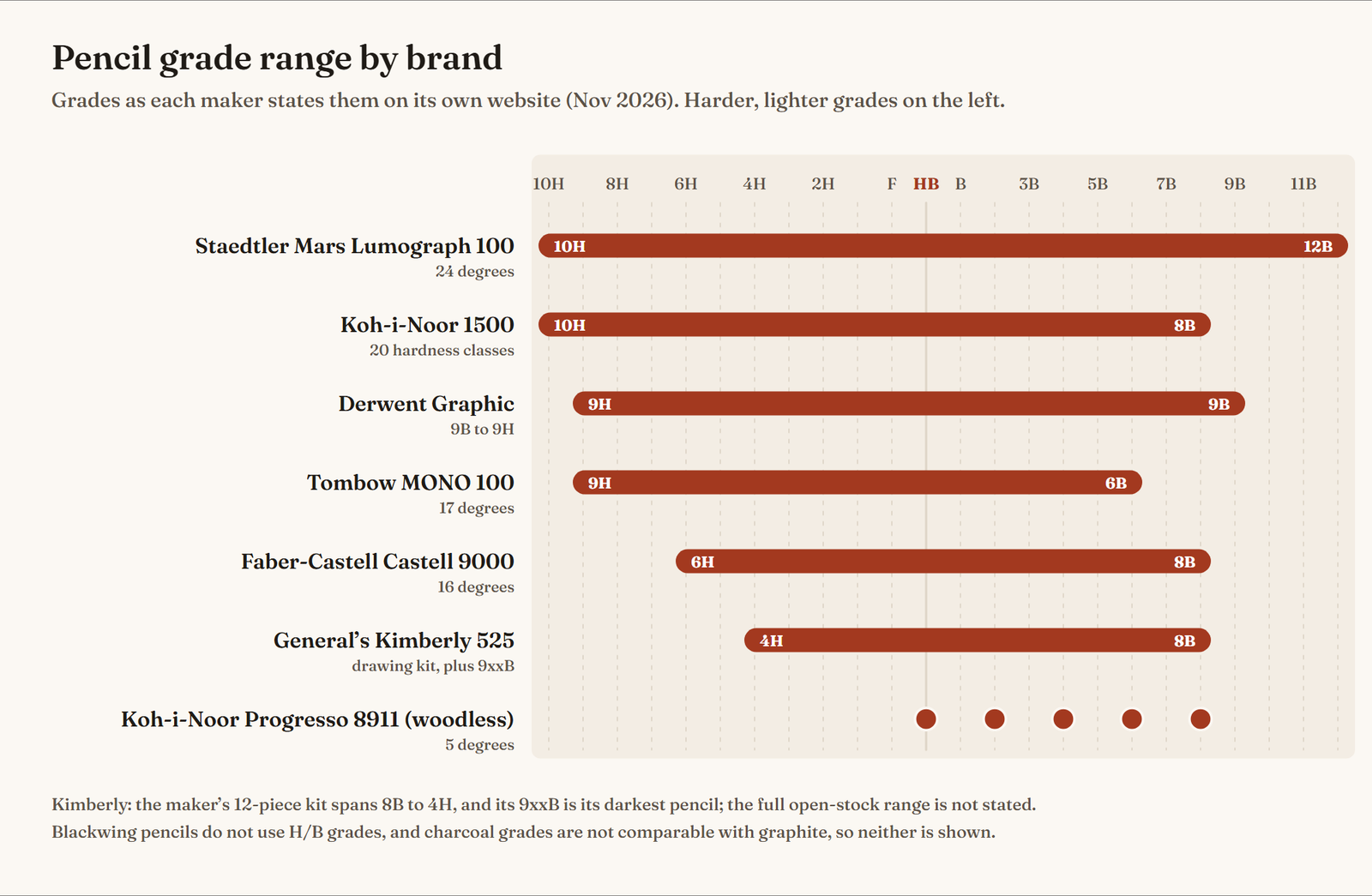
The best drawing pencils are the ones that cover the grades you actually use, sharpen cleanly and stay consistent from pencil to pencil. Our recommended drawing pencils below come from makers that still list them on their own websites, and every grade range on this page was checked on the maker’s site in November 2026. The picks cover different jobs: a full professional range, a classic everyday pencil, a beginner kit, pencils for sketchbooks, woodless graphite for loose tone and a charcoal pencil for deep blacks.
We don’t show product photos here. The chart at the top of the page and the diagrams below are our own, built from the makers’ published information.
How to choose drawing pencils
Good pencils to draw with share three things: an even lead without scratchy grit, wood that sharpens cleanly, and grades that stay consistent across the set. Beyond that, pick by what you draw:
- You’re just starting: a small kit with four to six grades, an eraser and a sharpener. General’s Kimberly Graphite Drawing Kit is built for this.
- You draw a lot and shade carefully: a full range from one brand, so your values stay consistent. Staedtler Mars Lumograph and Faber-Castell Castell 9000 are the classic choices.
- You mostly sketch in a sketchbook: one or two pencils you like the feel of, such as a Blackwing or an HB and 2B from any of the main brands.
- You work loose and large: woodless graphite or charcoal, which cover big areas quickly.
The drawing best pencil for you is the one whose grades match your style: people who draw light, careful lines need harder grades, and people who build dark, rich tone need softer ones.
Pencil grades explained: H, B and HB
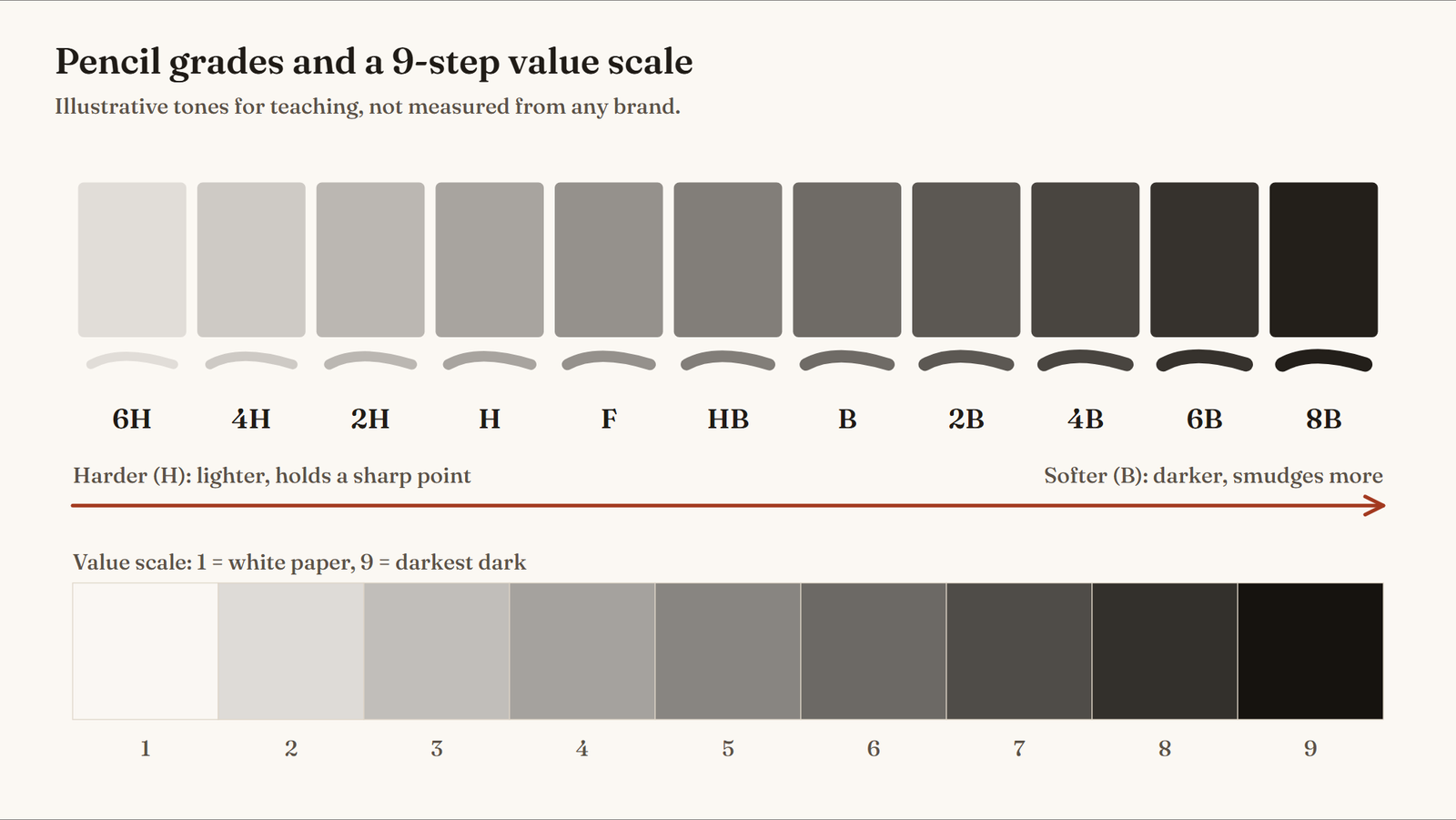
Drawing pencils are graded by hardness. H pencils are hard: the lead holds a sharp point and makes light, crisp lines. B pencils are soft and black: they make darker marks that blend and smudge easily. HB sits in the middle, and F (for fine) sits between HB and H. The number tells you how far along the scale a pencil is: a 6B is much softer and darker than a 2B, and a 4H much harder and lighter than an H.
Different types of drawing pencils cover different stretches of this scale. The chart at the top of this page shows the range each maker states: Staedtler’s Mars Lumograph runs from 12B to 10H, while Faber-Castell’s Castell 9000 runs from 8B to 6H. Grades are not standardized between brands, so a 2B from one maker can look lighter or darker than a 2B from another. That’s one reason artists often stick to one brand for shading.
What pencil should you use for sketching, and what pencil for finished drawing? A light drawing pencil (H or 2H) is good for construction lines you will erase later. HB and 2B suit general sketching and line work. 4B to 8B suit shading and the darkest accents. Our planned guide to types of drawing pencils will explain every grade in more depth.
Which pencil brand is best?
There’s no single best pencil brand; the pencil brands best known among artists each have a strength. Based on what the makers state on their own sites:
- Staedtler (Mars Lumograph 100) offers the widest stated range, 24 degrees from 12B to 10H.
- Faber-Castell (Castell 9000) offers 16 degrees from 8B to 6H, in a line the maker says it launched in 1905.
- Derwent (Graphic) runs from 9B to 9H and sells hard, medium and soft tins.
- Tombow (MONO 100) offers 17 degrees from 9H to 6B; the maker’s page says it has been on sale since 1967.
- Koh-i-Noor (1500) makes its classic pencil in 20 hardness classes, from 10H to 8B.
- General Pencil (Kimberly) sells a beginner kit spanning 8B to 4H and an extra-dark 9xxB.
- Blackwing describes its pencils by firmness instead of H/B grades.
All of these are good pencil brands for drawing. If you want one set to grow with, choose one of the first three; if you want a cheap starter, choose Koh-i-Noor or General’s.
Best drawing pencils for beginners
The best drawing pencils for beginners are a small, sensible set rather than a 24-pencil tin. A beginner drawing set needs only a few grades:
- 2H for light construction lines.
- HB for general drawing.
- 2B for line work and mid-tones.
- 4B or 6B for shadows.
Add a kneaded eraser, a plastic eraser and a sharpener, and you have everything you need. General’s Kimberly kit includes ten grades, an eraser and a sharpener in one box, which makes it the easiest single purchase. A 6- or 12-pencil tin from Staedtler, Faber-Castell or Derwent is the next step up and lasts for years, because most artists use only a few of the grades every day.
Pencils for shading
Shading pencils are simply the softer grades: 2B through 8B and beyond. The best shading pencils give you a smooth, even tone without grainy patches and blend cleanly with a tissue, stump or brush. For smooth gradients, use a light touch and build tone in layers rather than pressing hard with one pencil.
For the darkest values, choose a very soft grade (Staedtler goes to 12B, Derwent to 9B, General’s to its 9xxB), a woodless graphite pencil or charcoal. Charcoal gives the deepest, most matte blacks but smudges more than graphite and needs a fixative. A typical shading pencils order for a drawing is to block in light values with an HB or 2B, build mid-tones with a 4B, and save the 6B and softer for the final, darkest accents.
Pencils for sketching
Good pencils for sketching are the ones you enjoy holding and carrying. Most artists sketch with one or two grades: an HB or 2B for line, and a softer pencil for quick tone. A 2B is a good all-round sketching pencil because it’s dark enough to read clearly and hard enough to keep an edge.
For sketchbooks, Blackwing pitches its Pearl pencil at journaling and sketching; its pencils come with a replaceable eraser and describe their graphite by firmness rather than grade. Woodless pencils such as Koh-i-Noor’s Progresso 8911 suit loose, fast sketching where you want to lay down tone with the side of the lead. If you sketch on the go, a mechanical pencil saves you carrying a sharpener; our planned guide to mechanical pencils for drawing will cover those.
Wood-cased, woodless, mechanical and charcoal
All kinds of pencils turn up in an artist’s kit. Here’s how the main types compare:
- Wood-cased graphite (most picks on this list): the standard drawing pencil. Sharpen a long point for detail, or use the side for tone.
- Woodless graphite: a solid stick of graphite with a lacquer coat. Great for broad tone, but brittle.
- Mechanical pencils: fixed lead widths, no sharpening, very clean lines. Better for line work than for shading.
- Charcoal pencils: darker, matte marks and a softer feel. Ideal for figure drawing and value studies.
Colored and watercolor pencils are a different medium. If you’re curious about painting pencils, the same rule applies: start small and add colors as you need them.
How to use drawing pencils
How to draw with pencils well comes down to a few habits:
- Hold the pencil loosely and far back for long, light construction lines, and closer to the tip for detail.
- Start light. Use an H or HB for the first lines so you can correct them easily.
- Build value in layers. Several light layers look smoother than one heavy one, and they don’t polish the paper.
- Keep your point sharp for detail and blunt for broad tone. A craft knife and sandpaper give the longest points.
- Protect your drawing. Rest your hand on a scrap of paper so it doesn’t smudge the graphite.
What to draw with a pencil when you start? Simple objects around you: cups, boxes, shoes, and the pencil itself. Our figure drawing guide and our roundup of figure drawing books show how to move on to the human figure.
What great pencil drawings have in common
Amazing drawings with pencil don’t depend on an expensive set. The best drawings in pencil usually share a clear range of values, from untouched white paper to the darkest dark; varied edges, some sharp and some soft; and a sense of light coming from one direction. If you want easy drawings to start with, choose simple shapes under a single light, like an egg or a cup by a window, and focus on getting the values right before the details.
Good pencil drawings also show restraint: they leave some areas unfinished and let the paper do part of the work. Try copying a value scale like the one above with your own pencils before you start a drawing. It shows you how dark each of your grades can really go.
Bonus: how to draw a pencil
Drawings of pencils make a good first exercise, because a pencil is just a long cylinder with a cone on one end.
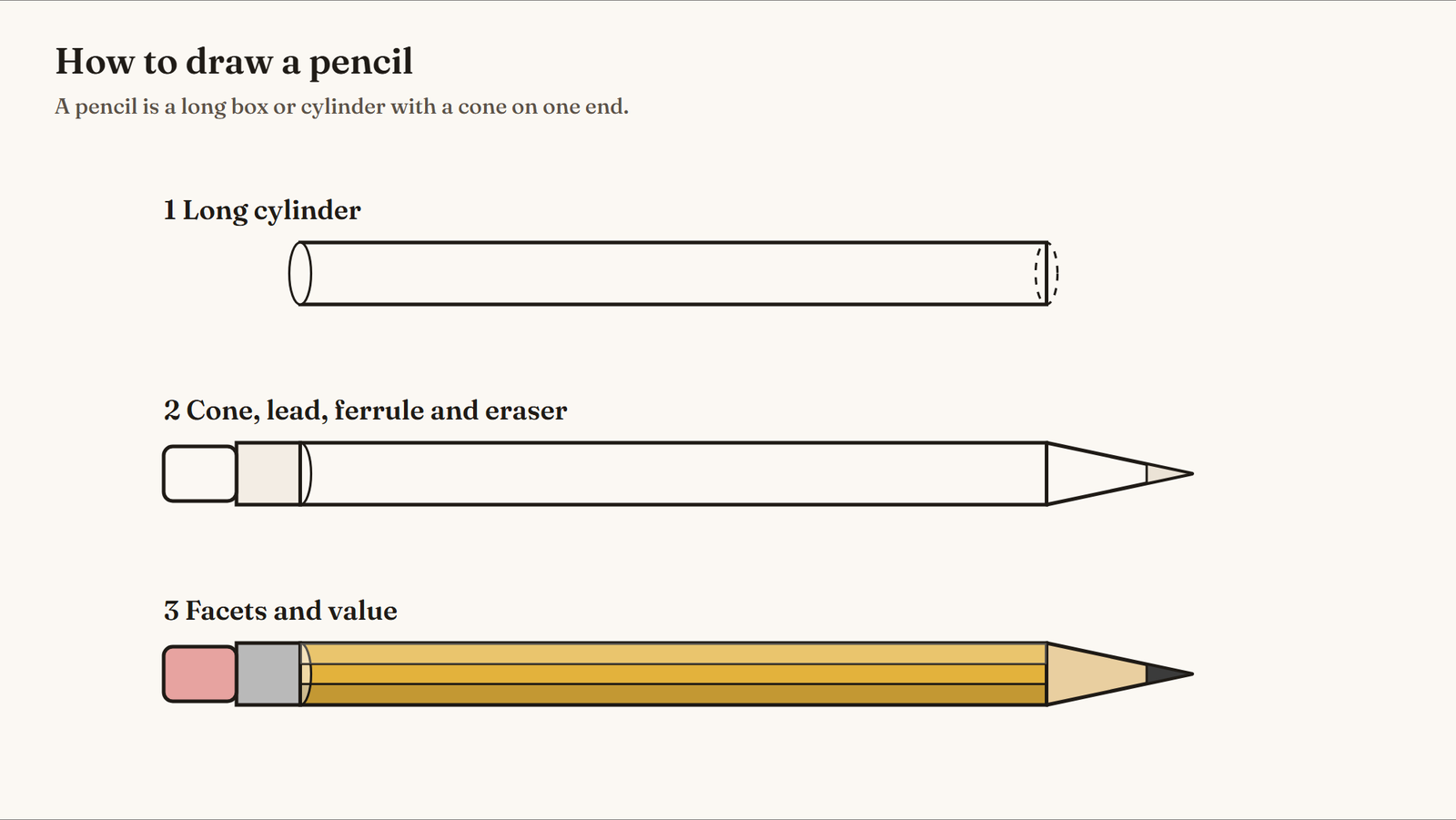
Draw a long, thin cylinder first. Add the sharpened cone and the graphite tip at one end, and the metal ferrule and eraser at the other. Finish with the flat facets of the hexagonal body and shade the side away from the light. A quick sketch of a pencil like this teaches you cylinders, cones and simple shading in a few minutes. For paper, sketchbooks and the rest of a kit, browse our art supplies guides.
Frequently asked questions
What are the best pencils for drawing?
For most artists, a set of Staedtler Mars Lumograph or Faber-Castell Castell 9000 pencils covers everything from light sketching to dark shading. Beginners can start with a small kit such as General's Kimberly Graphite Drawing Kit, which includes an eraser and a sharpener.
What pencil grades do you need to start drawing?
Three or four grades are enough: an H or 2H for light construction lines, an HB or 2B for general drawing, and a 4B and 6B for shading. Add harder or softer grades only when you notice you need them.
What is the difference between H and B pencils?
H stands for hard: the lead holds a sharp point and makes lighter lines. B stands for black: the lead is softer and makes darker marks that smudge more easily. HB sits in the middle, and F sits between HB and H.
Are mechanical pencils good for drawing?
Yes, for clean lines and fine detail, because the lead never needs sharpening. Wood-cased pencils are better for shading, since you can sharpen a long point and use the side of the lead.
Can you mix pencil brands?
Yes, but grades are not standardized between makers, so a 2B from one brand can look different from a 2B from another. Many artists keep one brand for shading so their values stay consistent.
Sources
- Mars Lumograph 100 drawing pencil (24 degrees, 12B to 10H; lead diameters), STAEDTLER. Accessed .
- Castell 9000 graphite pencil HB (degrees 8B to 6H), Faber-Castell. Accessed .
- Castell 9000 product line (launched 1905), Faber-Castell. Accessed .
- Graphic Pencils (9B to 9H), Derwent. Accessed .
- MONO 100 (17 degrees, 9H to 6B; on sale since 1967), in Japanese, Tombow Pencil. Accessed .
- Graphite pencils 1500 (20 hardness classes), Koh-i-Noor Hardtmuth. Accessed .
- Graphite pencils 1500 10H, Koh-i-Noor Hardtmuth. Accessed .
- Graphite pencils 1500 8B, Koh-i-Noor Hardtmuth. Accessed .
- Woodless graphite pencil 8911 (HB, 2B, 4B, 6B, 8B), Koh-i-Noor Hardtmuth. Accessed .
- Kimberly Graphite Drawing Kit, 12 pieces (8B to 4H), General Pencil Company. Accessed .
- Kimberly 9xxB Extra Extra Black Drawing Graphite, General Pencil Company. Accessed .
- General's Charcoal Pencil (HB, 2B, 4B, 6B), General Pencil Company. Accessed .
- Blackwing 602 (Set of 12), Blackwing. Accessed .
- Blackwing Pearl Pencils (Set of 12), Blackwing. Accessed .