The Best Figure Drawing Books (Beginner to Advanced)
Part of The Best Drawing Supplies: What Artists Actually Need
| Award | Product | Best for | Price | Link |
|---|---|---|---|---|
| Best for beginners | Figure Drawing for Artists: Making Every Mark Count | a clear, structured start: simple shapes and forms, built up step by step | Price tier 2 of 3 | Check price |
| Best classic | Figure Drawing for All It's Worth | proportion, the mannequin and how the figure is built, in a long-standing classic | Price tier 2 of 3 | Check price |
| Best for gesture | FORCE: Dynamic Life Drawing (10th Anniversary Edition) | loosening up stiff figures with a focus on energy, rhythm and force | Price tier 2 of 3 | Check price |
| Best for drawing from imagination | Figure Drawing: Design and Invention | a bridge from gesture to construction, with simplified forms you can invent with | Price tier 2 of 3 | Check price |
| Best workbook-style gesture course | Vilppu Drawing Manual | gesture and form practice organized as a sequence of exercises | Price tier 2 of 3 | Check price |
| Best compact anatomy series | Morpho: Anatomy for Artists | small, focused anatomy books you can carry and draw from | Price tier 1 of 3 | Check price |
| Best for foreshortening and action | Dynamic Figure Drawing | dramatic poses, foreshortening and figures in deep space | Price tier 1 of 3 | Check price |
| Best in-depth anatomy for figure drawing | Classic Human Anatomy in Motion | detailed anatomy for figures in movement, once the basics are in place | Price tier 2 of 3 | Check price |
Our picks
Best for beginners
Figure Drawing for Artists: Making Every Mark Count
Best for: a clear, structured start: simple shapes and forms, built up step by step
Pros
- Organized as a progression from simple forms to the full figure
- Recent edition (2016) that is easy to find
Cons
- Gesture gets less space than in a dedicated gesture book
Best classic
Figure Drawing for All It's Worth
Best for: proportion, the mannequin and how the figure is built, in a long-standing classic
Pros
- First published in 1943 and still in print in a modern edition
- Covers proportion, construction and the figure in action
Cons
- Dated language and fashion in the examples
- Idealized proportions that you should measure against real reference
Best for gesture
FORCE: Dynamic Life Drawing (10th Anniversary Edition)
Best for: loosening up stiff figures with a focus on energy, rhythm and force
Pros
- Built entirely around gesture and movement
- Anniversary edition listed by the publisher
Cons
- Not an anatomy reference; pair it with a construction or anatomy book
Best for drawing from imagination
Figure Drawing: Design and Invention
Best for: a bridge from gesture to construction, with simplified forms you can invent with
Pros
- Connects gesture, simple forms and anatomy in one system
- Useful for character and concept work
Cons
- Dense; works best after some basic practice
Best workbook-style gesture course
Vilppu Drawing Manual
Best for: gesture and form practice organized as a sequence of exercises
Pros
- Exercise-led, so it doubles as a practice plan
- Strong on gesture, rhythm and simple forms
Cons
- Several printings and editions exist, so check the ISBN when ordering
Best compact anatomy series
Morpho: Anatomy for Artists
Best for: small, focused anatomy books you can carry and draw from
Pros
- Part of a series with separate volumes such as Simplified Forms and Hands and Feet
- Compact format that suits quick study sessions
Cons
- Each volume covers a narrow topic, so you may want several
Best for foreshortening and action
Dynamic Figure Drawing
Best for: dramatic poses, foreshortening and figures in deep space
Pros
- Focused on figures in motion and in perspective
- A long-standing classic of figure construction
Cons
- Highly stylized, muscular figures; not a realistic anatomy reference
Best in-depth anatomy for figure drawing
Classic Human Anatomy in Motion
Best for: detailed anatomy for figures in movement, once the basics are in place
Pros
- Anatomy explained with the figure in motion in mind
- Deep reference you can grow into
Cons
- Too detailed as a first book
- Large book, less convenient to carry
The best figure drawing books teach one of three things: gesture (how a pose moves), construction (how the body is built from simple forms) and anatomy (what is under the skin). This guide sorts the books artists most often recommend by level and focus, so you can build a short shelf of books to draw from instead of buying a stack you never open. Every edition and ISBN was checked against the Open Library catalog in November 2026, and there is one excellent public-domain book you can read free.
We don’t show book covers: they are copyrighted, and we only use product images through Amazon’s own tools. The graphics on this page are our own.
How to choose a figure drawing book
Before you pick, decide what your drawings need most right now:
- Stiff figures? You need a gesture book. Gesture books teach the line of action and the rhythm of a pose, which is what makes a figure feel alive.
- Figures that look flat or wobbly? You need a construction book. These teach the body as simple 3D forms (eggs, boxes, cylinders) that you can turn in space.
- Figures that look right but generic? You need an anatomy book. Anatomy explains the bumps, hollows and muscle shapes that make a figure specific.
Most artists work through them in that order: gesture and construction first, anatomy after. A good starter shelf is one book from each column of the map below. Whatever you choose, draw from the book while you read it; a figure drawing book you copy from for a month beats three you only read.
Figure drawing books by level
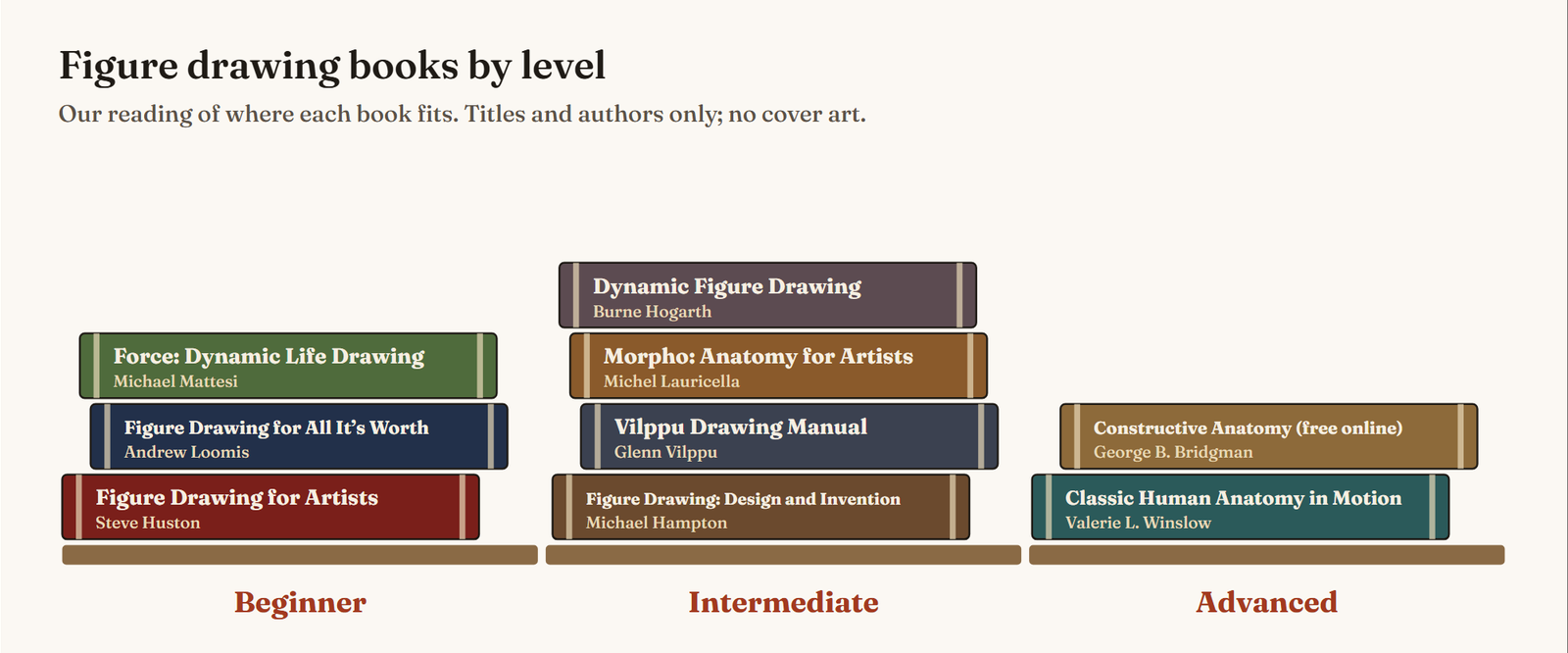
The bookshelf at the top of this page and the map below place each pick by level and focus. They are our reading of each book, not a ranking.
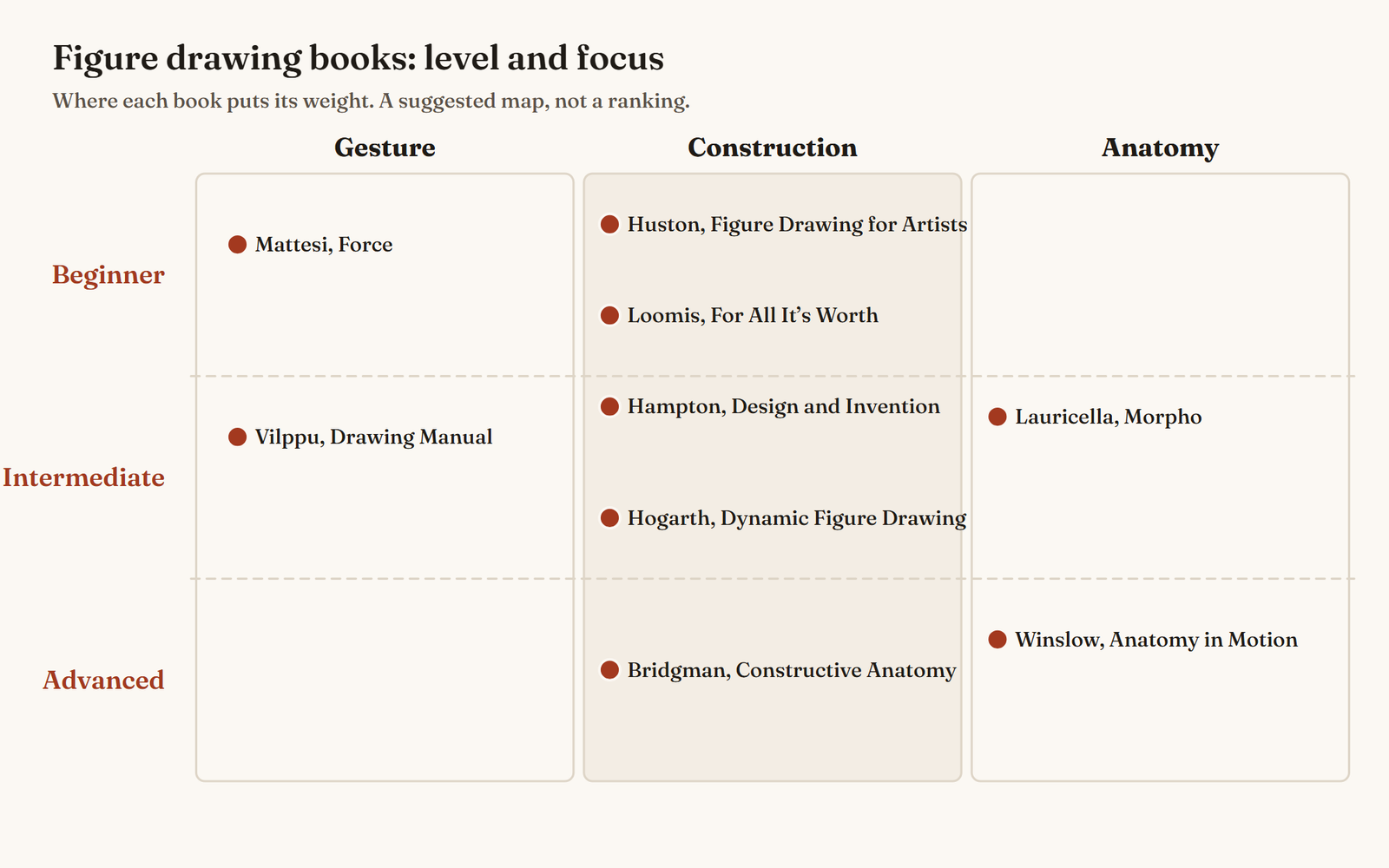
Beginner. Steve Huston’s Figure Drawing for Artists and Andrew Loomis’s Figure Drawing for All It’s Worth are the clearest starting points for construction, and Mike Mattesi’s Force is the gentlest way into gesture. If you only buy one book to start, choose based on your weak point: stiff figures, start with Force; wobbly figures, start with Huston or Loomis.
Intermediate. Michael Hampton’s Figure Drawing: Design and Invention and the Vilppu Drawing Manual connect gesture and form into a system you can draw from imagination. Burne Hogarth’s Dynamic Figure Drawing pushes into foreshortening and dramatic action. The Morpho series is a compact way into anatomy.
Advanced. Valerie Winslow’s Classic Human Anatomy in Motion is a deep anatomy reference for figures that move. George Bridgman’s Constructive Anatomy, free online, rewards study once you know the basics.
Gesture and life drawing books
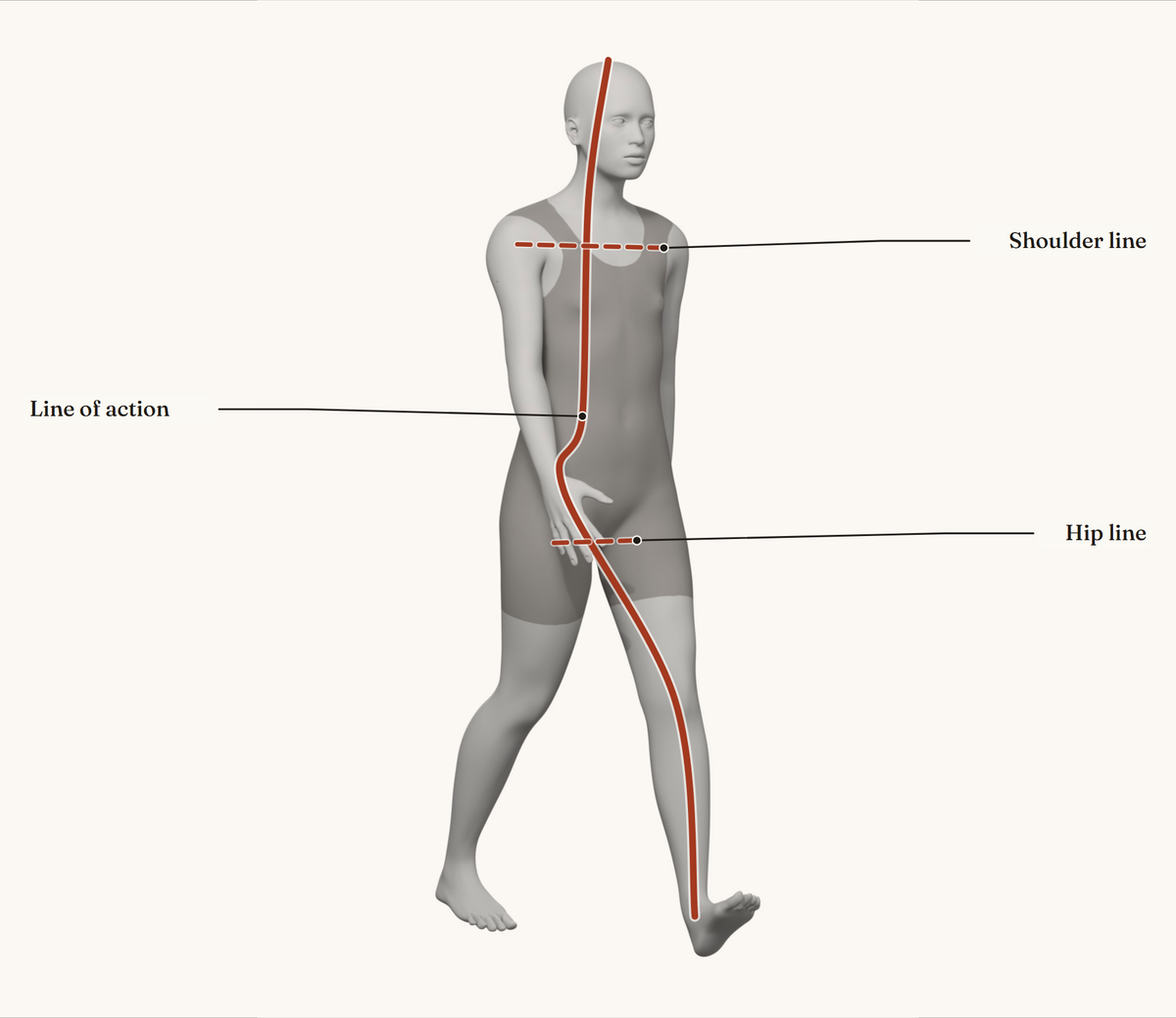
Gesture is the part of figure drawing most beginners skip and most teachers start with. A gesture drawing book trains you to see the whole pose in seconds: the line of action, the tilt of the shoulders and hips, and the rhythm between the limbs.
Two books on this list focus on it:
- Mattesi’s Force builds everything around energy and movement. It is the best fit if your figures come out stiff or posed.
- The Vilppu Drawing Manual is built around exercises, which makes it a good companion for timed sessions and life drawing classes.
For daily gesture practice to go with these books, use the timed tools in our guide to the best gesture drawing sites. Our planned guide to gesture drawing will cover the technique itself.
Construction books
Construction books teach the figure as a set of simple, solid forms: a head, a rib cage, a pelvis and limbs you can rotate in space. This is the layer that makes figures look three-dimensional and lets you draw from imagination.
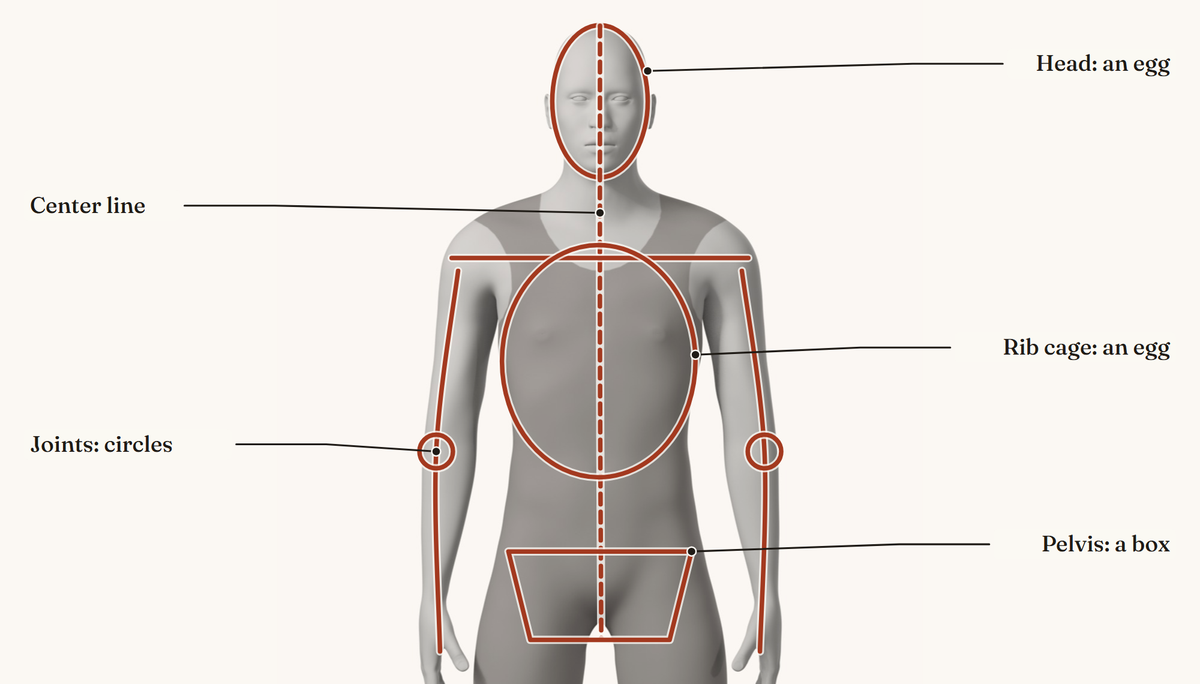
Huston, Loomis, Hampton and Hogarth all teach construction, each with a different flavor. Huston and Loomis are the most methodical for beginners. Hampton is the most useful if you want to invent figures for characters and concept art. Hogarth is the most dramatic, with exaggerated, muscular figures that are great for action and foreshortening but not a realistic anatomy reference.
Anatomy books for figure drawing
Anatomy books for figure drawing are different from medical anatomy books: they focus on the forms you see at the surface and how they change when the body moves. They help most once you can already build a figure that stands and moves.
- The Morpho series by Michel Lauricella breaks anatomy into small, focused volumes. Morpho: Anatomy for Artists is a good entry, and the publisher lists other volumes, such as Simplified Forms, Hands and Feet and Clothing Folds and Creases.
- Winslow’s Classic Human Anatomy in Motion is a detailed reference that keeps the figure in action. It is a book to grow into rather than a first purchase.
If anatomy is your main goal, our anatomy drawing guide covers the essentials with labeled figures, and our planned roundup of the best anatomy books for artists will go deeper into anatomy-only titles.
A free classic: Bridgman’s Constructive Anatomy
George B. Bridgman’s Constructive Anatomy was published around 1920, is in the public domain, and is free to read on the Internet Archive. It shows the body as interlocking masses, drawn with a sculptor’s sense of form, and it pairs well with any construction book on this list. Printed editions also exist, but you don’t need to buy one to study it.
How to study with these books
Reading a figure drawing book changes little; drawing from it changes a lot. A simple routine:
- Pick one book and one chapter. Don’t start three books at once.
- Copy the examples. Draw each diagram or figure in the chapter, slowly, paying attention to how it is built.
- Apply it to reference. Draw the same idea from a photo, a 3D figure or a live model. Our figure drawing guide has poses with and without line-of-action overlays you can use.
- Draw from memory. Close the book and redraw the idea without looking. Compare and correct.
- Mix in timed gesture. Ten minutes of fast poses at the start of every session keeps construction from making your figures stiff.
This works for female and male figure drawing alike: the construction and anatomy are the same, and the differences in proportion are easiest to see when you measure real reference instead of copying a book’s idealized canon.
Books, courses or both?
Books and video courses teach the same skills in different ways. A book is cheap, lets you study one page for as long as you need, and works well for copying diagrams. A video course shows the drawing happening in real time, which is especially useful for gesture, where speed and confidence matter. Many artists use both: a course for demonstrations and a book as a reference to return to. Whichever you choose, the habit that makes the difference is the same: draw from it every day, then test what you learned on real reference and from memory. Our planned roundup of figure drawing courses compares the options.
Looking for general drawing books?
This page is about figure drawing books specifically. If you are looking for drawing books in general (books that teach drawing from scratch, sketching for beginners, drawing practice books and art books for adults who are starting out), our planned roundup of the best drawing books for beginners covers those. For perspective, see our roundup of the best perspective drawing books.
Bonus: how to draw a stack of books
Some readers arrive here looking for something different: how to draw books themselves, as a subject. A stack of books is a great perspective exercise, because each book is a simple box.
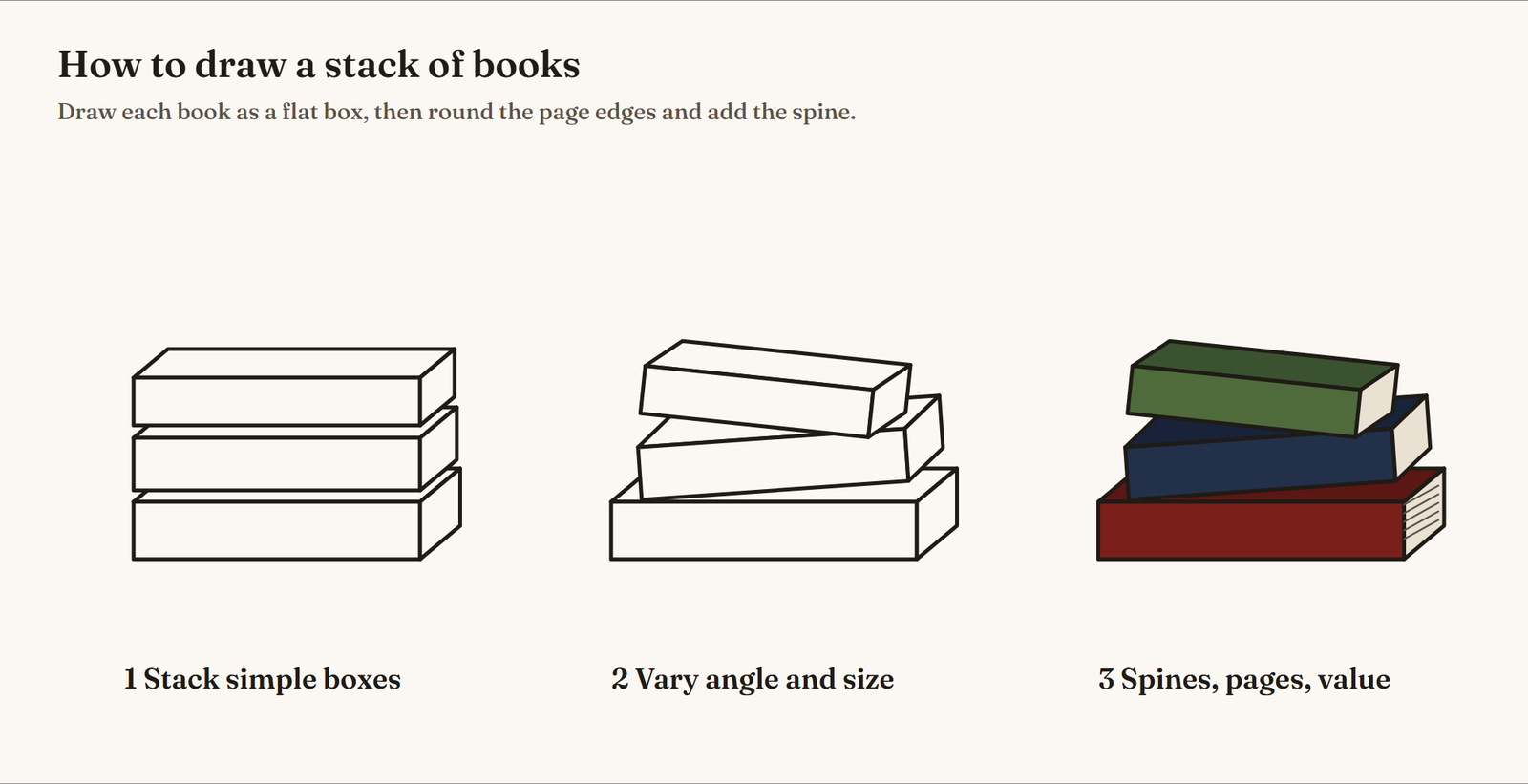
- Draw simple boxes. Stack three flat boxes, each sitting on the one below.
- Vary the angle and size. Turn each box a little and make them different sizes so the stack looks natural.
- Add spines, pages and value. Round the spines slightly, draw thin lines on the page edges, and shade the sides darker than the tops.
The same steps work for an open book (a box with a folded top), a book on a shelf or an old book with a worn cover. For more on boxes in perspective, see our planned guide to perspective drawing.
Frequently asked questions
What is the best figure drawing book for beginners?
Steve Huston's Figure Drawing for Artists is a clear, structured start, and Andrew Loomis's Figure Drawing for All It's Worth is the long-standing classic. Pair either with a gesture book such as Mike Mattesi's Force so your figures don't get stiff.
Should I start with gesture, construction or anatomy books?
Gesture and construction first, anatomy after. A figure needs movement and solid simple forms before muscle detail helps it; anatomy books such as Morpho or Winslow make more sense once you can build a believable mannequin.
Are there free figure drawing books?
Yes. George Bridgman's Constructive Anatomy (1920) is in the public domain and free to read on the Internet Archive. Our own figure drawing and anatomy guides are free too.
Is Loomis still worth reading?
Yes, for proportion and construction. The language and examples are dated, and the proportions are idealized, so measure them against real reference rather than copying them as rules.
How many figure drawing books do I need?
Usually two or three: one for gesture, one for construction and, later, one for anatomy. Drawing from one book regularly teaches more than reading several.
Sources
- Figure drawing for artists: making every mark count (ISBN 9781631590658), Open Library. Accessed .
- Figure drawing for all it's worth, Titan Books (ISBN 9780857680983), Open Library. Accessed .
- FORCE: Dynamic Life Drawing, 10th Anniversary Edition, Routledge / CRC Press. Accessed .
- Figure drawing: design and invention (ISBN 9780615272818), Open Library. Accessed .
- Vilppu Drawing Manual, Vilppu Studio 2017 (ISBN 9780999455807), Open Library. Accessed .
- Morpho series, Rocky Nook. Accessed .
- Morpho: Anatomy for Artists (ISBN 9781681983745), Open Library. Accessed .
- Dynamic Figure Drawing (ISBN 9780823015771), Open Library. Accessed .
- Classic human anatomy in motion (ISBN 9780770434144), Open Library. Accessed .
- Figure drawing for all it's worth (work record, first published 1943), Open Library. Accessed .
- Constructive Anatomy (George B. Bridgman, c1920), item record, Internet Archive. Accessed .