The Best Perspective Drawing Books for Artists
Part of The Best Drawing Supplies: What Artists Actually Need
| Award | Product | Best for | Price | Link |
|---|---|---|---|---|
| Best first perspective book | Perspective Made Easy | absolute beginners who want the basics explained simply | Price tier 1 of 3 | Check price |
| Best classic | Successful Drawing | perspective as part of drawing anything, from boxes to figures | Price tier 2 of 3 | Check price |
| Best beginner book for comics | Vanishing Point: Perspective for Comics from the Ground Up | comic and illustration artists starting perspective from zero | Price tier 2 of 3 | Check price |
| Best for comics and characters | Perspective! for Comic Book Artists | comic artists who want perspective explained in comic form | Price tier 2 of 3 | Check price |
| Best for storytelling | Framed Perspective Vol. 1: Technical Perspective and Visual Storytelling | illustrators and storyboard artists who want technical perspective tied to composition | Price tier 3 of 3 | Check price |
| Best for characters and shadows | Framed Perspective Vol. 2: Technical Drawing for Shadows, Volume, and Characters | drawing characters, volume and cast shadows in perspective | Price tier 3 of 3 | Check price |
| Best for designers and concept artists | How to Draw: Drawing and Sketching Objects and Environments from Your Imagination | drawing objects, vehicles and environments from imagination with accurate perspective | Price tier 3 of 3 | Check price |
Our picks
Best first perspective book
Perspective Made Easy
Best for: absolute beginners who want the basics explained simply
Pros
- Short and approachable, with many simple illustrated examples
- Inexpensive reprint of a book first published in 1939
Cons
- Old-fashioned examples
- Stops before complex scenes and figures
Best classic
Successful Drawing
Best for: perspective as part of drawing anything, from boxes to figures
Pros
- Connects perspective to everyday drawing and the figure
- Modern edition of a 1951 classic
Cons
- Dated language and examples
Best beginner book for comics
Vanishing Point: Perspective for Comics from the Ground Up
Best for: comic and illustration artists starting perspective from zero
Pros
- Builds from the ground up, as the subtitle promises
- Examples aimed at comics and storytelling
Cons
- Less useful for technical or product drawing
Best for comics and characters
Perspective! for Comic Book Artists
Best for: comic artists who want perspective explained in comic form
Pros
- Taught as a comic, which makes the ideas easy to follow
- Covers figures and scenes in perspective, not only boxes
Cons
- Older edition; some techniques assume traditional tools
Best for storytelling
Framed Perspective Vol. 1: Technical Perspective and Visual Storytelling
Best for: illustrators and storyboard artists who want technical perspective tied to composition
Pros
- Technical perspective explained with storytelling in mind
- Publisher still lists it
Cons
- Assumes you are comfortable with basic drawing
Best for characters and shadows
Framed Perspective Vol. 2: Technical Drawing for Shadows, Volume, and Characters
Best for: drawing characters, volume and cast shadows in perspective
Pros
- Focuses on figures, volume and shadows, as the subtitle says
- Pairs naturally with Vol. 1
Cons
- Best read after Vol. 1
Best for designers and concept artists
How to Draw: Drawing and Sketching Objects and Environments from Your Imagination
Best for: drawing objects, vehicles and environments from imagination with accurate perspective
Pros
- Thorough, technical treatment of perspective for design
- Useful for vehicles and products as well as scenes
Cons
- Demanding for beginners
- Little on figures
A good perspective drawing book turns a confusing subject into a set of simple rules you can use every day: a horizon line, vanishing points and boxes that sit convincingly in space. The books below cover every level, from a short beginner’s guide first published in 1939 to technical books used by concept artists and storyboard artists. Each edition and ISBN was checked against the Open Library catalog in November 2026, and the picks are grouped so you can find the right book for what you draw: everyday scenes, comics and characters, or designs from imagination.
We don’t show book covers, which are copyrighted. The diagrams on this page are our own.
How to choose a perspective book
Start from what you want to draw, not from which book is most famous:
- You’re new to perspective: pick a short, simple book first. Perspective Made Easy and Loomis’s Successful Drawing explain the basics without overwhelming you.
- You draw comics or illustrations: pick a book that teaches perspective through panels and characters, such as Vanishing Point, Perspective! for Comic Book Artists or Framed Perspective.
- You want to design objects, vehicles or environments: How to Draw by Scott Robertson with Thomas Bertling is the most thorough and technical choice on the list.
One book, worked through with a pencil and a ruler, teaches more than three books skimmed. Most perspective books are full of exercises; do them.
Perspective drawing books by level
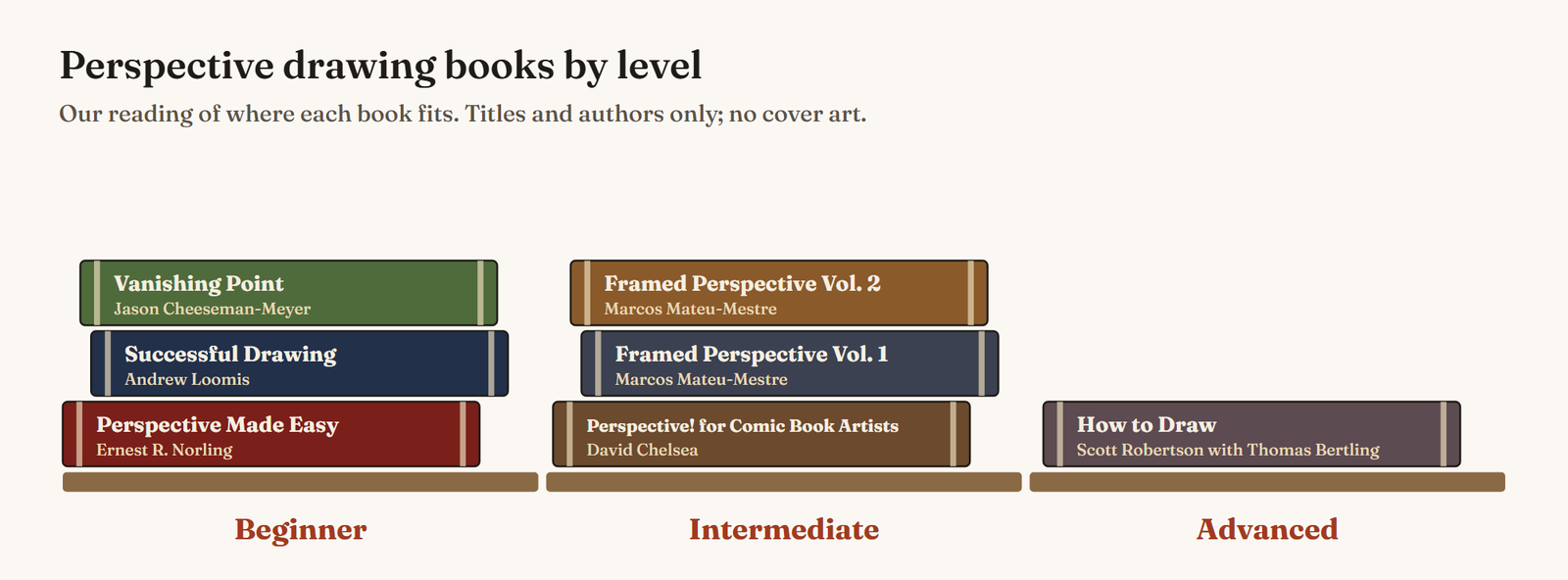
The bookshelf at the top of this page shows our reading of each book’s level. A typical path is one beginner book, then one intermediate book that matches your field. Only a few artists need the advanced, technical level, but for designers and concept artists it is worth the effort.
Beginner: Perspective Made Easy (Norling), Successful Drawing (Loomis), Vanishing Point (Cheeseman-Meyer).
Intermediate: Perspective! for Comic Book Artists (Chelsea), Framed Perspective Vol. 1 and Vol. 2 (Mateu-Mestre).
Advanced: How to Draw (Robertson with Bertling).
What perspective books cover
Almost every perspective book builds from the same foundations: the horizon or eye level, vanishing points, and the three common systems of one-, two- and three-point perspective. The art of perspective is learning when to use each, and how to bend the rules for a dramatic picture.
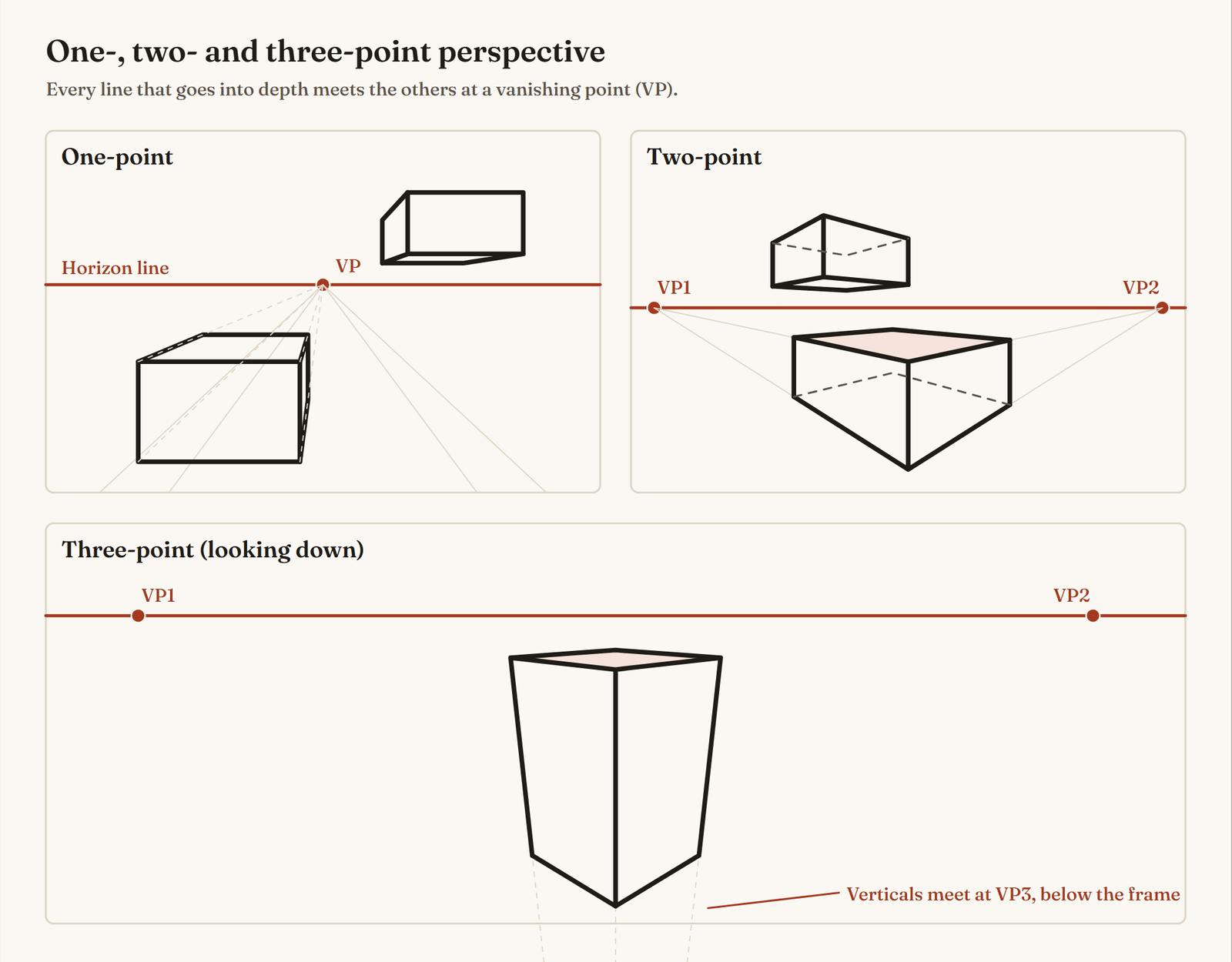
- One-point perspective: one vanishing point on the horizon; good for roads, corridors and rooms seen head-on.
- Two-point perspective: two vanishing points; the standard for buildings, boxes and most objects seen from a corner.
- Three-point perspective: a third vanishing point above or below; for tall buildings, extreme angles and dramatic shots.
Beyond the basics, the more advanced books cover ellipses and circles in perspective, dividing and repeating spaces, inclined planes such as roofs and stairs, cast shadows, and reflections. Robertson’s How to Draw also covers drawing cars and other vehicles in perspective, and the space and environment work concept artists do.
If you collect perspective art reference, these books also help you analyze it: once you can find the horizon and vanishing points in a picture, you can see why a scene feels deep, tilted or calm.
Perspective books for comics and characters
Many perspective books stop at boxes and buildings. If you draw comics, illustration or storyboards, you need to draw characters in perspective too: figures that stand on the same floor as the room around them, shrink correctly with distance, and stay in proportion when the camera tilts.
Three books on the list focus on this:
- Perspective! for Comic Book Artists by David Chelsea teaches perspective as a comic, with figures and scenes, not only boxes.
- Vanishing Point by Jason Cheeseman-Meyer covers perspective for comics from the ground up, as its subtitle says.
- Framed Perspective Vol. 2 by Marcos Mateu-Mestre focuses on shadows, volume and characters.
A simple trick these books teach for drawing figures in perspective: put every standing figure’s eyes on the horizon line when the camera is at standing eye height. Then figures near and far stay on the same floor, and only their size changes. Our figure drawing guide covers the figure itself, and our roundup of figure drawing books pairs well with this list.
How to learn perspective with these books
Perspective is learned by drawing, not by reading, and a free course makes a good companion to any book here (see our Drawabox review). A simple plan that works with any book on this list:
- Learn the vocabulary. Horizon line, vanishing point, eye level, picture plane. A beginner book covers these in a few chapters.
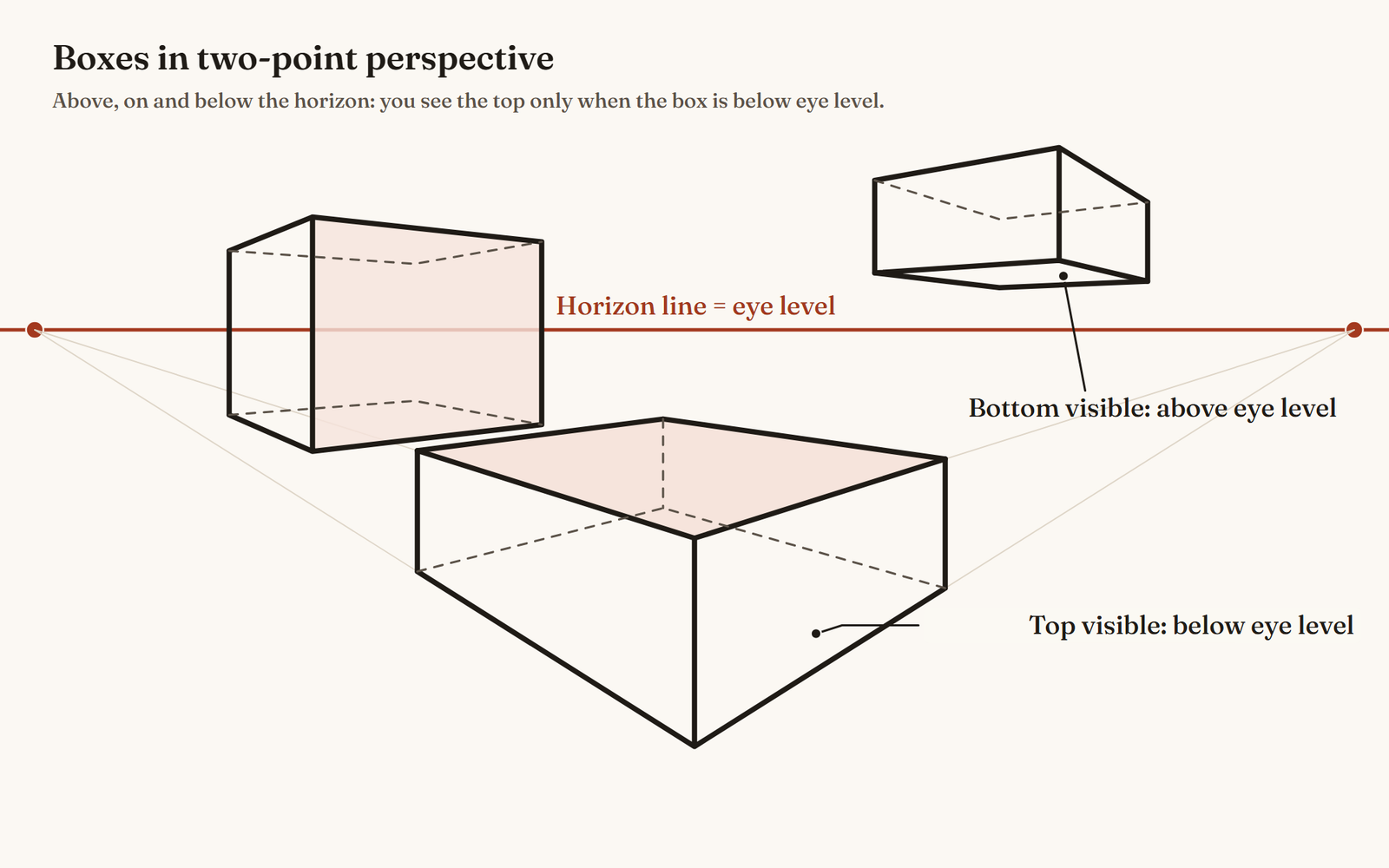
- Draw boxes, lots of them. Boxes above, on and below the eye level, in one- and two-point perspective. Every complex object starts as a box.
- Add circles and ellipses. Cylinders, wheels and cups are boxes with ellipses inside.
- Draw what’s around you. A room, a street, a stack of books. Find the horizon and vanishing points before you draw.
- Move to figures and scenes. Use a comics or storytelling book to put characters into spaces.
Practice in short sessions and keep your pages. Beginner perspective drawing improves quickly when you repeat the same exercises over a few weeks. Our planned guide to perspective drawing will cover the technique step by step.
Tools you need for the exercises
Perspective books assume a few simple tools. You don’t need anything special: a pencil, an eraser, a ruler or straightedge, and paper large enough to place vanishing points far apart. Many artists tape a sheet to a larger board or table so vanishing points can sit off the page, and use a long ruler or a piece of string pinned at the vanishing point to draw converging lines quickly. Our guide to drawing supplies covers the basics.
Common perspective mistakes these books fix
Most perspective problems in drawings come from a handful of mistakes, and every book on this list addresses them:
- Horizon line in the wrong place. If the horizon isn’t fixed first, objects in the same picture seem to be seen from different heights. Decide the eye level before anything else.
- Vanishing points too close together. Two-point perspective with vanishing points crowded on the page distorts boxes into sharp, stretched shapes. Push the vanishing points far apart, often off the page.
- Ellipses that tilt the wrong way. A circle in perspective becomes an ellipse whose shape depends on the eye level; a common mistake is drawing every ellipse the same. The intermediate books cover this in detail.
- Figures floating or sinking. Characters that don’t share the floor with the scene break the picture. Placing eye levels and contact points first fixes most of it.
- Inconsistent scale. Objects that should be the same size look different because they weren’t measured against the horizon. Simple measuring tricks keep a whole scene consistent.
Perspective and drawing from observation
Perspective books teach rules; observation teaches you to see. They work best together, and our drawing fundamentals guides cover both. When you draw a room or a street from life, try to find the horizon and the vanishing points in what you see, then check your drawing against them. When you invent a scene, use the rules to make it convincing, then compare it with real photos to see what the rules leave out, such as atmospheric haze or the slight curve of wide-angle views. Switching between the two is how perspective becomes a tool you use without thinking, rather than a construction you add afterward.
Drawing a book in perspective
Some readers are looking for something else: how to draw a book, or a stack of books, so it looks right. It is one of the best beginner perspective exercises, because each book is simply a box with a spine.
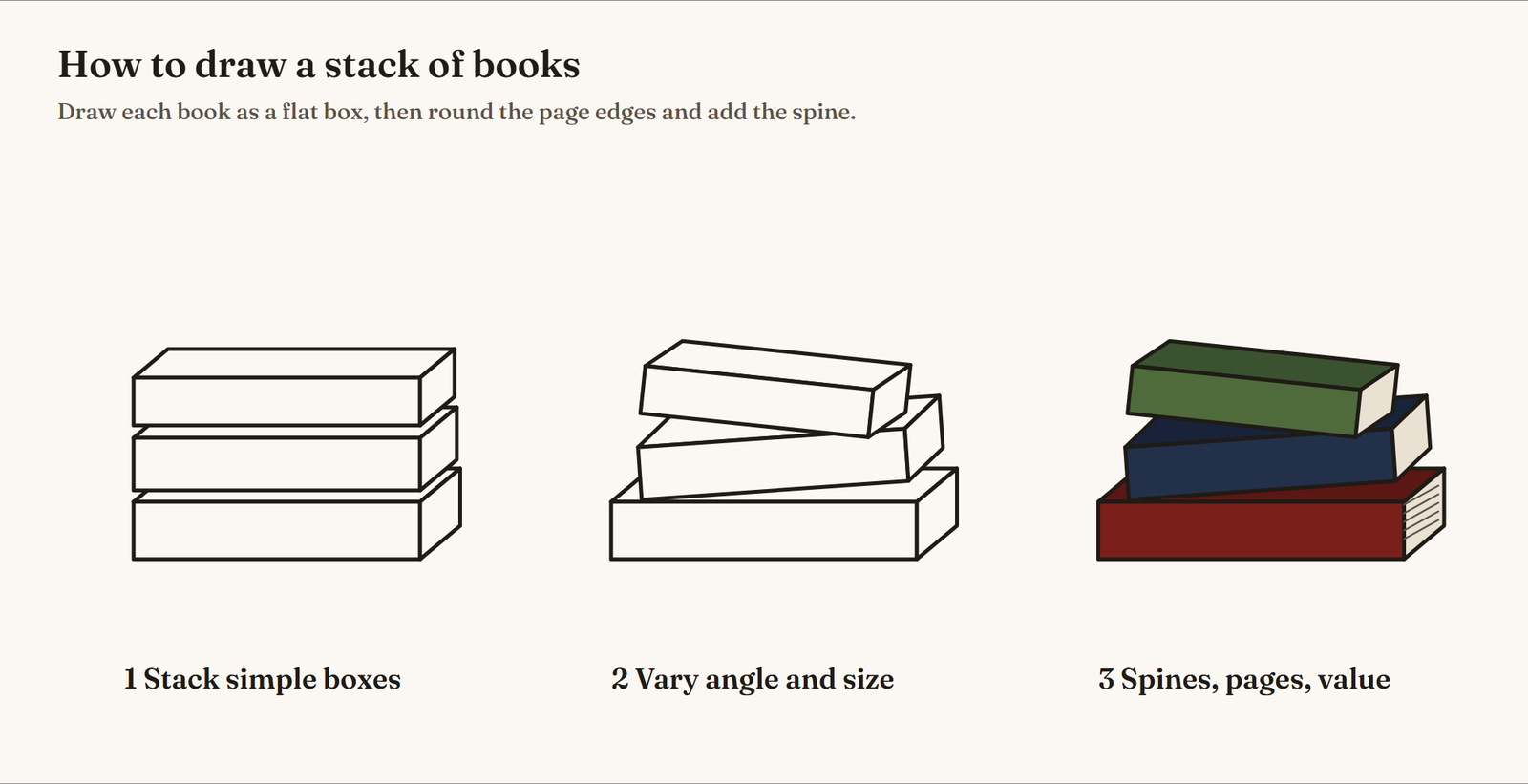
To draw a book easily, draw a flat box first, then round the spine slightly and add thin lines along the page edges. For an open book, fold the top of the box into two gentle slopes. Reading a book drawing correctly is the same skill in reverse: find the box hidden in it.
Do you need more than one perspective book?
Most artists need two at most: one clear beginner book for the rules and one book from their own field (comics, storytelling or design) for applying them. The beginner books overlap a lot, so buying several of them adds little. The advanced books overlap less, because each one is written for a different kind of artist: Mateu-Mestre for storytelling and characters, Robertson and Bertling for designing objects and environments. If you are unsure, start with the beginner book that matches your field, finish it, and only then decide whether you need the technical depth of the advanced ones.
Frequently asked questions
What is the best perspective book for beginners?
Ernest Norling's Perspective Made Easy is the simplest starting point. If you draw comics, Jason Cheeseman-Meyer's Vanishing Point builds perspective from the ground up with comic-style examples.
Is How to Draw by Scott Robertson good for beginners?
It is thorough and demanding. It suits artists who already draw a little and want accurate perspective for objects, vehicles and environments. Beginners usually get more from Norling or Loomis first.
What is the difference between Framed Perspective Vol. 1 and Vol. 2?
Vol. 1 covers technical perspective and visual storytelling; Vol. 2 covers shadows, volume and characters, as their subtitles say. Most readers start with Vol. 1.
Which perspective book is best for drawing characters?
Framed Perspective Vol. 2 and David Chelsea's Perspective! for Comic Book Artists both deal with figures in perspective, which most basic books skip.
Can I learn perspective without a book?
Yes. The basics fit on a few pages: a horizon line, vanishing points and boxes. A book helps when you move on to complex scenes, figures and shadows, where a structured explanation saves a lot of trial and error.
Sources
- Perspective made easy, Dover 1999 (ISBN 9780486404738), Open Library. Accessed .
- Perspective Made Easy (work record, first published 1939), Open Library. Accessed .
- Successful Drawing, Titan Books 2012 (ISBN 9780857687616), Open Library. Accessed .
- Vanishing Point (ISBN 9781581809541), Open Library. Accessed .
- Perspective! For Comic Book Artists (ISBN 9780823005673), Open Library. Accessed .
- Framed Perspective Vol. 1 (ISBN 9781624650307), Open Library. Accessed .
- Framed Perspective Vol. 2 (ISBN 9781624650321), Open Library. Accessed .
- How to Draw (ISBN 9781933492735), Open Library. Accessed .
- Design Studio Press catalog (How To Draw; Framed Perspective), Design Studio Press. Accessed .